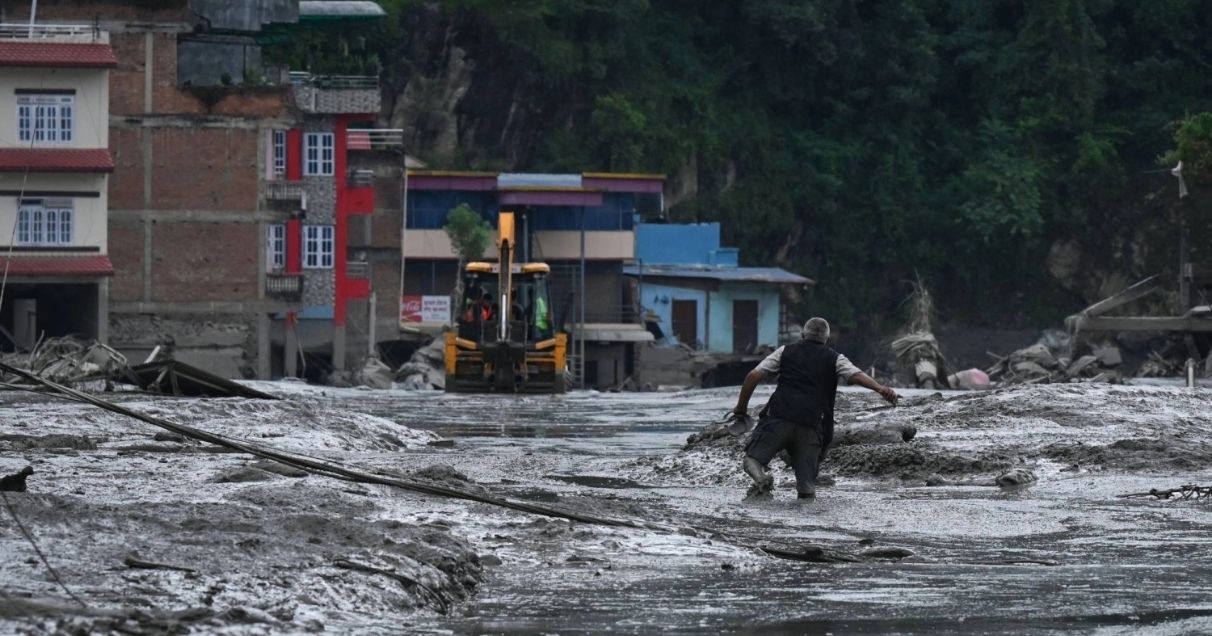
Nepal is grappling with the aftermath of devastating flash floods that struck Rasuwa and several other parts of central Nepal after an ice-and-rock avalanche linked to a glacial collapse near the China border.
Nepal Police has put the death toll at 626, while more than 2,400 people remain unaccounted for across Nepal and Tibet. The disaster has damaged or destroyed roads, bridges, homes, settlements and hydropower facilities, leaving several areas difficult to access.
Nepal's National Disaster Risk Reduction and Management Authority reported 1,924 people missing in Nepal and 554 in Tibet. Officials have warned that the figures could change as search teams reach more affected areas and authorities continue verifying reports.
Among those missing are hundreds of foreign nationals. Nepal's disaster management authorities said 517 foreigners, including tourists and foreign workers, remain unaccounted for. Chinese authorities have separately reported 260 foreign nationals missing in areas on their side of the border.
Search operations continue in worst-hit areas
The Nepal Tourism Board said 121 tourists had been rescued following the floods and landslides. The overall number of people rescued, including local residents and foreign workers, has not yet been established.
In Tibet, Chinese rescue teams reached the severely affected Gyirong border area on Friday after flood damage cut off road access. A 21-member team accompanied by a search-and-rescue dog travelled through difficult mountainous terrain and used ropes to cross forests and steep sections.
Surveillance footage from the area showed floodwater and debris sweeping through buildings, while people attempted to escape the rapidly rising water.
Flood threat remains after lake forms upstream
The immediate disaster has been followed by concerns over another potential flood.
Floodwater created a lake that began spilling towards the Lhende Khola and Trishuli river systems on Friday. The development prompted warnings in Nepal and temporarily disrupted rescue operations.
Search operations were halted for around three hours as authorities assessed the danger. Chinese rescue teams and vehicles also moved away from the area as a precaution.
Operations resumed after the immediate threat from the overflowing lake eased. Nepali authorities continued searching for survivors despite difficult terrain and unstable conditions.
Two barrier lakes upstream are being monitored in Nepal. Officials have warned that the flood threat may continue until the accumulated water drains.
Satellite observations indicated that one of the lakes was continuing to expand without an obvious outlet. Chinese experts have also warned that the region's numerous glacial lakes could create additional risks.
China warns of possible lake breach
Chinese authorities have cautioned Nepal that the newly formed lake could breach its natural barrier.
The water level was reported to be rising gradually, while the water itself had become increasingly dark, a development Chinese authorities said could indicate increasing instability.
China's Ministry of Water Resources estimated that approximately 2.5 million cubic metres of water had accumulated in the lake by Friday. Earlier assessments suggested that another 3 million cubic metres could be added over the following three days.
Chinese flood modelling indicated that a partial breach could produce a peak flow of up to 500 cubic metres per second. Beijing's assessment suggested that the resulting water would probably remain within the riverbanks, potentially limiting the impact further downstream.
International rescue teams join operations
Nepal initially decided to rely on its own rescue teams and did not immediately seek international search-and-rescue assistance.
As the scale of the disaster became clearer and hundreds remained missing, the country subsequently opened its operations to specialist teams from India, China, Australia and South Korea.
The international teams are assisting with areas including tunnel rescues, DNA identification and forensic operations.
The involvement of specialist teams is expected to help authorities identify victims and locate people who remain unaccounted for in areas affected by flooding and landslides.
Nepal faces huge reconstruction bill
The disaster has caused extensive damage to infrastructure and communities, creating a major financial challenge for Nepal.
The country's Finance Minister has estimated that $4 billion to $5 billion will be required for reconstruction following the floods.
The recovery effort is expected to involve rebuilding roads and bridges, restoring damaged hydropower infrastructure and supporting communities whose homes and livelihoods have been affected.
For now, rescue teams remain focused on locating those still missing, while authorities continue monitoring unstable water bodies and warning residents in the Bhotekoshi and Trishuli regions to move to safer areas if conditions deteriorate.