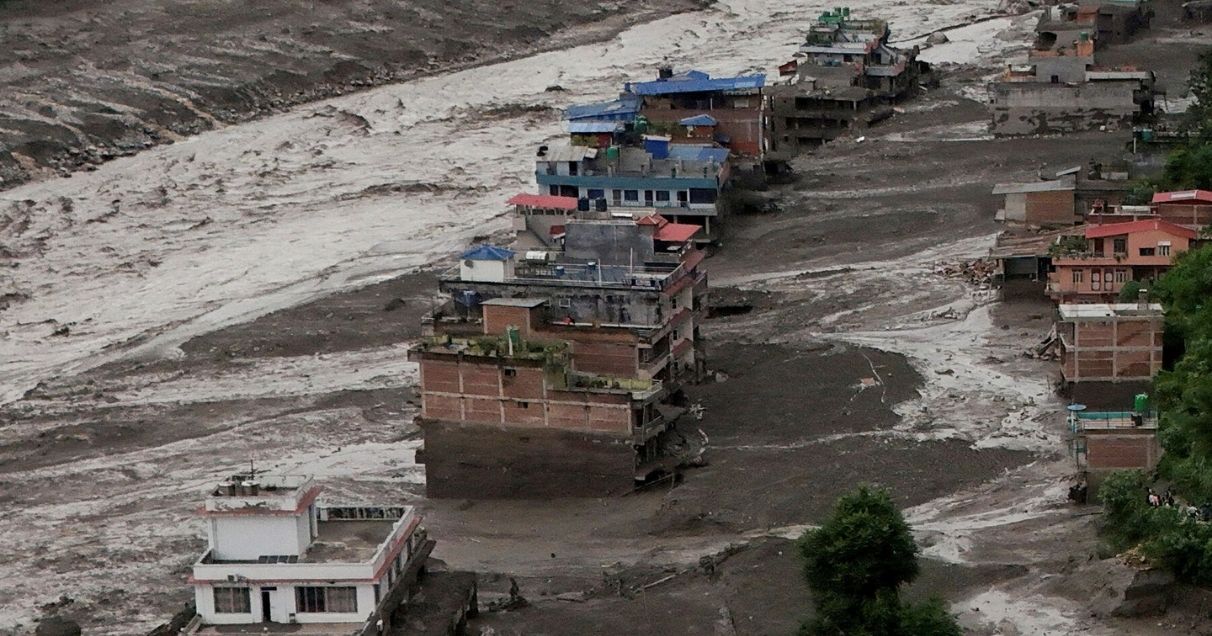
More than 1,000 people have been confirmed dead following catastrophic floods and landslides across Nepal and Tibet, as rescue agencies continue a massive operation to reach communities isolated by destroyed roads, collapsed bridges and enormous deposits of mud and debris.
The scale of the disaster continued to grow on Tuesday, with Nepal accounting for the overwhelming majority of reported casualties.
Nepal's disaster-management authorities have recorded 987 deaths, while another 3,916 people remain missing.
Among those unaccounted for are 583 foreign nationals, adding an international dimension to what is rapidly emerging as one of the Himalayan region's most devastating natural disasters in recent years.
Chinese authorities, in their latest reported update on Sunday, had confirmed another 16 fatalities.
Together, the reported figures have pushed the combined death toll in Nepal and Tibet beyond 1,000.
Nearly 12,000 rescued
Amid the devastation, an enormous rescue operation is underway.
Nepalese authorities say at least 11,814 people have been rescued so far.
Aircraft and helicopters have become critical to the operation because conventional access to several affected areas has been severed.
Floodwaters and landslides have destroyed stretches of roads and swept away bridges, leaving some communities accessible primarily from the air.
Emergency personnel are attempting to locate survivors, evacuate injured residents and deliver essential supplies to settlements that remain cut off.
With thousands still missing, authorities face the possibility that the casualty figures could rise substantially as rescuers gain access to remote areas.
Disaster began high in the Himalayas
The extraordinary flooding appears to have originated with a violent geological and glacial event high in the Himalayan mountains on August 26.
A major collapse involving a glacier and the rock beneath it sent enormous quantities of ice, rock and meltwater crashing into valleys below.
The initial collapse triggered a rapidly developing sequence of events.
Water mixed with rock, mud and glacial debris surged into downstream river systems, producing powerful floods that travelled through valleys extending across parts of Tibet and Nepal.
Communities downstream had little protection against the enormous volume and force of the material moving through the river systems.
Homes and other structures were swept away, while roads and bridges disappeared beneath floodwaters or were destroyed by debris.
Collapse registered as seismic event
Scientists examining satellite data are attempting to reconstruct precisely what happened in the mountains.
Early assessments indicate that the event may have involved the failure of bedrock beneath a glacier rather than simply the movement of surface ice.
The collapse was so powerful that its seismic signature was comparable to a magnitude 5.2 event.
The enormous mass of falling material subsequently displaced and mobilised water, ice and sediment, creating a destructive surge that moved into the valleys below.
Such events can become particularly dangerous in steep Himalayan terrain because gravity allows water and debris to accelerate rapidly before reaching populated areas downstream.
Entire communities remain difficult to reach
The destruction of transportation infrastructure has complicated the rescue operation.
Where roads once connected mountain settlements, emergency crews are now confronting collapsed slopes, washed-out bridges and thick deposits of rocks and mud.
Helicopters and other aircraft are therefore being used to locate stranded residents and reach areas inaccessible by road.
The immediate priority remains finding survivors among the thousands listed as missing.
Authorities must simultaneously provide shelter, food, drinking water and medical assistance to people displaced by the floods.
The presence of hundreds of missing foreign nationals is also expected to require coordination with multiple governments as identification and search operations continue.
Himalayan disaster exposes vulnerability of mountain communities
The catastrophe has again demonstrated the extraordinary destructive potential of events originating in the high Himalayas.
A geological failure in a remote glacial environment can rapidly become a humanitarian disaster many kilometres downstream, particularly when enormous quantities of ice, rock and water enter established river systems.
Scientists are expected to continue analysing satellite imagery and seismic information to determine the precise sequence behind the August 26 collapse.
For rescue workers on the ground, however, the immediate challenge is much more urgent.
Almost 4,000 people remain missing in Nepal alone.
And with numerous communities still difficult to access, the complete human cost of the Himalayan catastrophe may not yet be known.
What began with a collapse high in the mountains became a wall of water, ice, rock and mud — and for thousands of families across Nepal and Tibet, the search for their loved ones is still not over.