1. The lake at Dudhala
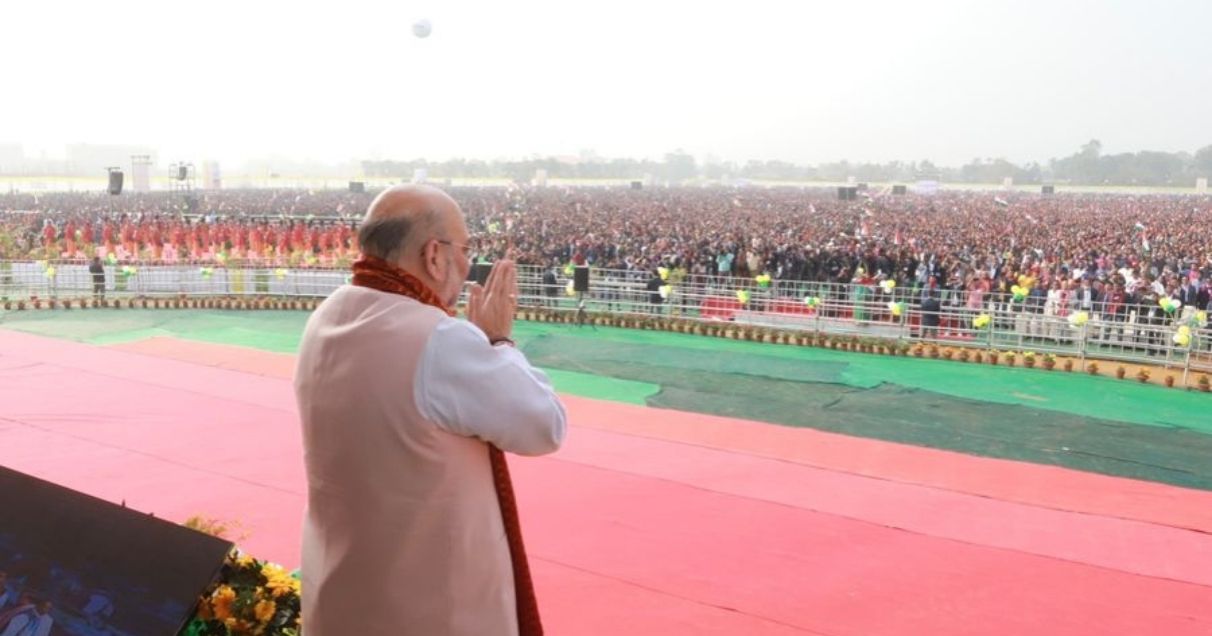
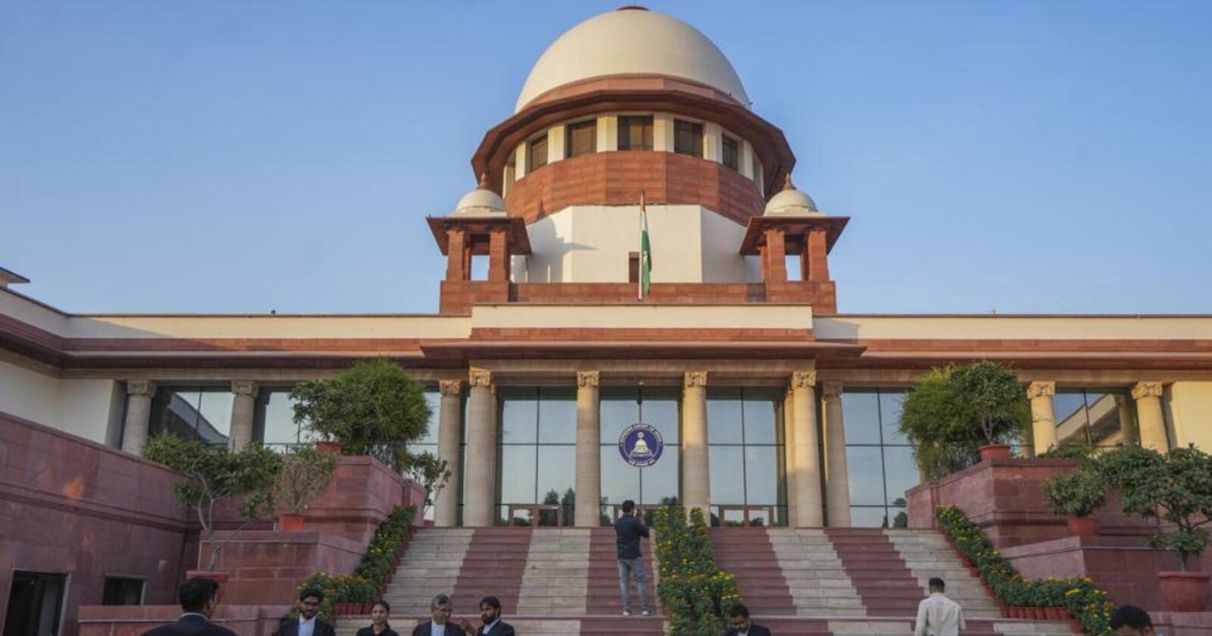
On Thursday, 27 August 2026, in Dudhala village in Gujarat’s Amreli district, Union Home and Cooperation Minister Amit Shah inaugurated the Gujarat Gaurav Sarovar,’a newly built reservoir on the Gagadiyo river, spread over roughly 21 acres, constructed by the Dholakia Foundation at a reported cost of about Rs 4 crore. Gujarat Deputy Chief Minister Harsh Sanghavi was present, and described the revival of Saurashtra’s dried-up rivers as a gift to future generations.
Shah praised Savjibhai Dholakia for having built 208 lakes over a lifetime, and said the work had done more than dig water,’it had spread a culture of conservation across Saurashtra. Then he made the remark that led the next morning’s papers.
The Padma Shri, the Padma Bhushan, the Padma Vibhushan and the Bharat Ratna, he said, are not honours for families, nor for acquaintances and relatives; they are for people who devote their whole lives to the country and its poor without asking for praise. And he added the line that gave the story its edge: Savjibhai had told him he never even applied, and Shah’s response was that if a man who has built 208 lakes still has to fill in a form, the government deserves to be called useless for failing to notice him.
It is worth pausing on the setting. Savji Dholakia received the Padma Shri in 2022, in the Social Work category, from then-President Ram Nath Kovind. Govind Dholakia, founder-chairman of Shree Ramkrishna Exports, another Dudhala-born diamantaire based in Surat,’ has sat in the Rajya Sabha as a BJP member since April 2024, elected unopposed from Gujarat alongside the party’s then-president J.P. Nadda. Shah, in the same speech, recalled his conversations with the Rajya Sabha MP and the foundation’s work in South Gujarat: temples, satsangs, schools, tribal children reciting Sanskrit. The Indian Express account of the speech records Shah attributing Govind Dholakia’s elevation to the Upper House to the Prime Minister’s wish.
So the sentence “these awards are not for families” was delivered at a family’s event, about a family’s philanthropy, in a village that has produced one Padma Shri and one Member of Parliament,’the honour and the seat both arriving, on the minister’s own account, without the recipients having to ask.
Nothing here is evidence of impropriety. Both men have long, documented, independently reported records. But the moment is a near-perfect illustration of why India has argued about the Padma Awards for seventy-two years, and why the argument got sharper, not softer, during the decade in which the government set out to fix it.
2. What the rulebook actually says
The formal machinery is not secret. It is published, and it is worth setting out precisely, because almost every dispute about the Padma Awards is a dispute about the gap between what the rulebook covers and what it leaves out.
What is written down
• Instituted in 1954, alongside the Bharat Ratna. Three grades: Padma Vibhushan for exceptional and distinguished service, Padma Bhushan for distinguished service of a high order, Padma Shri for distinguished service in any field.
• Nominations are open to anyone. Self-nomination is expressly permitted. Since the 2017 cycle they are accepted online only, currently through the Rashtriya Puraskar Portal, with the window running roughly from May to July.
• Nominations are additionally invited from all state and union territory governments, central ministries, Institutes of Excellence, and every living Bharat Ratna and Padma Vibhushan awardee. Recommendations also arrive from Governors, Chief Ministers, Union Ministers, MPs, private bodies and individuals.
• Everything is compiled into citations and placed before the Padma Awards Committee, which the Prime Minister constitutes afresh every year. It is chaired by the Cabinet Secretary and includes the Home Secretary, the Secretary to the President, and four to six eminent persons.
• The committee is directed to look for lifetime achievement. The stated standard is “excellence plus,” and an element of public service in the nominee’s work is a desirable factor.
• Shortlisted names undergo due diligence, including verification by investigating and intelligence agencies.
• The committee’s recommendations go to the Prime Minister and the President for approval. No Padma is conferred except on the committee’s recommendation.
• The annual cap is 120, excluding posthumous awards and awards to foreigners, NRIs, PIOs and OCIs. A higher grade normally follows an earlier one only after five years.
• The award is not a title and cannot be used as a prefix or suffix to a name.
• Consent is sought before the announcement. This is why refusals are so rare, and so newsworthy when they happen.
What is not written down anywhere
This is the shorter list, and the more consequential one.
1. No citation explaining why any individual was selected. The published entry is a name, a discipline and a state, four or five words.
2. No shortlist, no vote count, no minutes, no dissent recorded or released.
3. No record of which channel produced a given awardee: a citizen nomination, a state government’s search committee, a Union minister’s letter, an institution, or a self-nomination.
4. No routine advance disclosure of the four to six “eminent persons” on the committee in any given year.
5. No appeal, no review, and no ordinary mechanism by which a conferred award is revisited.
A rare glimpse of the funnel’s actual shape came through the Right to Information Act years ago, when the Home Ministry was directed by the Central Information Commission to disclose Padma deliberations. In that year, the final 130 recipients were drawn from 1,163 names discussed by the committee across two batches, and the disclosure also showed that several names recommended by the Prime Minister’s Office had not made the final list. The Ministry attached a caveat asking that the information not be given to the press, which the then Chief Information Commissioner said the RTI Act does not permit.
That episode belongs to an earlier government. The point it establishes is structural, not partisan: names reach the committee through political channels; some are taken and some are dropped; and in neither case is a reason ever published.
3. The decade in numbers
Between 2014 and 2026 the intake side of the Padma system was transformed, and the output side was not. The table below sets the two against each other.
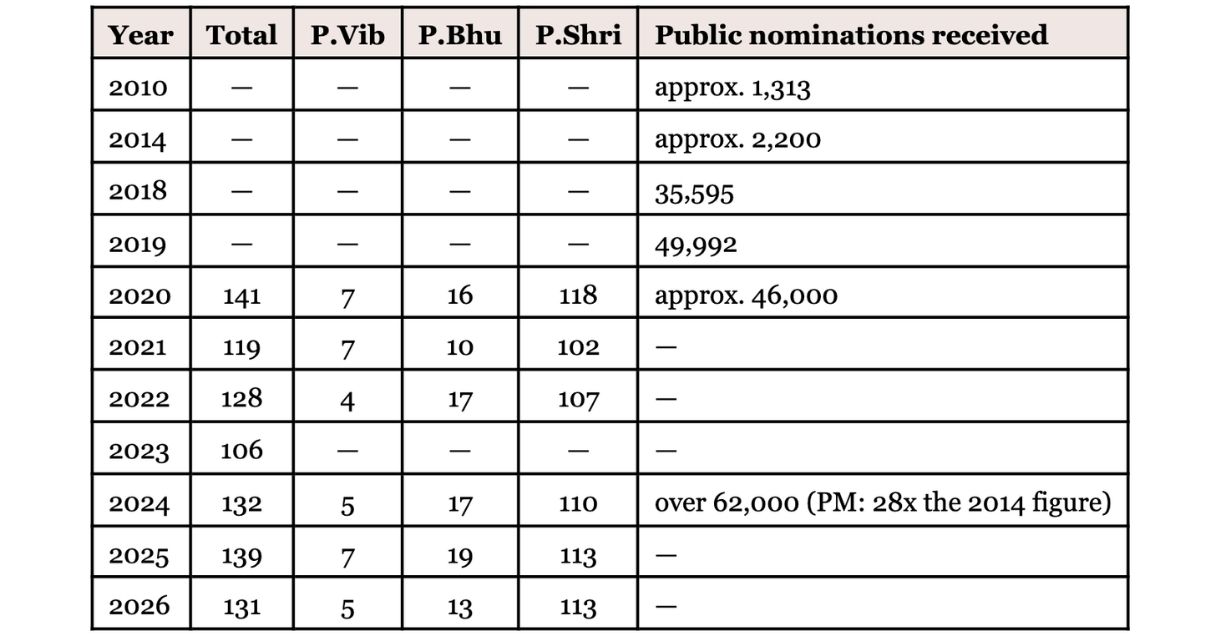
Figures compiled from Home Ministry / PIB announcements and contemporaneous news reports. Dashes indicate figures not located in the sources consulted; 2023 sub-totals unverified.
Read the two columns together. A system that weighed roughly two thousand names a decade ago now weighs more than sixty thousand and still confers about 130 awards. On the 2024 figures, the odds against any individual nomination were roughly 470 to 1.
That ratio is the single most important fact in this story, and both sides of the argument can use it without lying.
The government’s reading: it proves the awards are no longer a closed shop. The critics’ reading: a 470-to-1 funnel with no published reasoning is not a competition, it is a shortlisting exercise conducted where nobody can see it. Sixty thousand nominations do not constrain a committee of a dozen people. They supply it with cover.
Both readings are fully consistent with the same number. That is precisely the problem, and it is the reason the same list can be celebrated and denounced within the same hour every 25th of January.
4. The four currencies
Strip away the annual noise and the decade sorts into four ways of ending up with a Padma. They are not mutually exclusive. Most awards involve more than one. The trouble is that from the outside, nobody can tell which.
Currency one: Merit
Something real did change, and it is not spin to say so.
From roughly 2015 onwards, Padma Shri lists consistently began carrying names that would never have surfaced on a Delhi shortlist. Saalumarada Thimmakka, who spent decades planting and tending trees along a Karnataka highway. Ravindra and Smita Kolhe, who treated tribal patients in Melghat for a token fee. Kamala Pujhari, the Odisha tribal farmer who conserved hundreds of indigenous seed varieties. Pappammal, an organic farmer honoured past the age of a hundred. Chutni Devi, branded a witch and driven from her home, who turned that into a campaign against witch-hunting. Meenakshi Amma, teaching Kalaripayattu in her seventies. Bipin Ganatra, Kolkata’s volunteer firefighter. Dr Ravi Kannan of the Cachar Cancer Hospital in Assam’s Barak Valley. Hemchand Manjhi, a traditional medicine practitioner in Chhattisgarh. Sangthankima, who runs Mizoram’s largest orphanage. Yanung Jamoh Lego of Arunachal Pradesh.
In 2017 the Prime Minister’s Office pointed out, unprompted, that not a single doctor from Delhi featured in the medicine category, presented explicitly as a break from a pattern in which physicians to the rich and famous were reliably pushed forward by patrons. Whatever else one thinks of the framing, the observation was accurate.
This shift is documented, sustained across ten lists, and in many individual cases genuinely moving. Any honest account of the decade has to concede it.
Currency two: Luck
But being deserving and being visible are different things, and in a 470-to-1 funnel the second is decisive.
Whether your work reaches the committee depends on whether somebody with institutional standing wrote it up: a state government’s special search committee — the Home Ministry began formally asking states to constitute these from the 2022 cycle, precisely because deserving people who avoid publicity were being missed , or a district officer, an MP, an institution, or a journalist who happened to profile you.
And the geography has been stubborn for a long time. An analysis around 2016 found that just seven states accounted for about 63 per cent of all Padma Shri recipients over the preceding sixteen years, and that Padma Shri numbers rose by roughly 30 per cent in election years. A decade later, commentary on the 2026 list noted three states holding around 18 per cent of India’s population taking about 37 per cent of the awards, with three of the five Padma Vibhushans going to Kerala figures, read by some as overdue southern recognition and by others as a political quota.
A grassroots worker of identical merit in a district of Jharkhand and one in a district of Maharashtra do not face identical odds. Opening the online portal did not change that. It moved the bottleneck from the post office to the search committee.
Currency three: Relationship
Then there is the currency the official framing has least to say about. Across the decade, the Padma and Bharat Ratna lists have repeatedly tracked the ruling party’s ideological lineage and its electoral calendar closely enough that the pattern has become difficult to attribute to coincidence.
• Atal Bihari Vajpayee received the Bharat Ratna in 2015. L.K. Advani received the Padma Vibhushan in 2015 and the Bharat Ratna in 2024. Murli Manohar Joshi received the Padma Vibhushan in 2017, the BJP’s troika of the late 1980s and 1990s, honoured in sequence.
• The 2022 list carried posthumous Padma Vibhushans for Kalyan Singh, Uttar Pradesh’s Chief Minister at the time of the Babri Masjid demolition, and for Radheshyam Khemka of Gita Press , announced weeks before the Uttar Pradesh assembly election.
• In 2025, Sadhvi Ritambhara received the Padma Bhushan under Social Work. The Liberhan Commission had named her among 68 people it held individually culpable of taking the country to the brink of communal discord; she was charged by the CBI in the Babri case and later acquitted. She now runs a large residential institution for girls and destitute women. Critics called the award an endorsement of a politics of hate; supporters pointed to the institution. Both were describing the same person, and the two-word citation adjudicated nothing.
• Also honoured around the Ram temple’s consecration: its chief architect Chandrakant Sompura, and Ganeshwar Shastri Dravid, who fixed the auspicious hour for the ceremony.
• The 2026 list included a Padma Bhushan for Bhagat Singh Koshyari, whose term as Maharashtra Governor spanned the contested 2019 swearing-in and remarks about Shivaji and Phule that the Shiv Sena called an insult to the state.
The clearest single data point of the decade, though, is the 2024 Bharat Ratna round. Five awards were announced in one year. The convention is a maximum of three; it had been broken only once before, in 1999. The five were Karpoori Thakur, Bihar’s OBC icon, honoured as the state’s caste politics entered a period of churn; Chaudhary Charan Singh, the Jat farmer leader, announced as the RLD moved towards the NDA; P.V. Narasimha Rao, the Congress Prime Minister the Congress has long been ambivalent about; the agricultural scientist M.S. Swaminathan; and Advani.
That set of five is readable as long-overdue historical justice and as coalition arithmetic at the same time, by the same reader, without contradiction. Which is exactly what a system with no published reasoning guarantees.
Currency four: Trust
The fourth currency is the subtlest: some Padma Awards are messages. The recipient is the medium, and the audience is somewhere else.
The decade’s cross-party honours are the clearest examples, Sharad Pawar’s Padma Vibhushan in 2017; Ghulam Nabi Azad and Buddhadeb Bhattacharjee both offered the Padma Bhushan in 2022; Pranab Mukherjee’s Bharat Ratna in 2019; and in 2026, posthumous honours for the former Kerala Chief Minister V.S. Achuthanandan and the Jharkhand Mukti Morcha founder Shibu Soren.
The government reads these as proof that the list rises above party. Opponents read them as instruments for unsettling rivals. When Azad was named, the Congress leader M. Veerappa Moily said flatly that the decision was political rather than merit-based, and suggested Azad weigh whether accepting served the party. Jairam Ramesh’s jibe pointed the other way. Both readings, again, fit the same fact.
Buddhadeb Bhattacharjee refused outright, saying he had been told nothing about it and would not accept it. The CPI(M) noted that declining state awards was long-standing party policy, recalling E.M.S. Namboodiripad’s refusal of a Padma Vibhushan offered by the Narasimha Rao government in 1992. The same week, the singer Sandhya Mukhopadhyay, then ninety, with about eight decades of work behind her, declined a Padma Shri, her family saying she found the grade demeaning at her stature. The tabla player Anindya Chatterjee also declined.
Those three refusals in a single January told the public something no official document does. Consent is sought before the announcement. Which means, unavoidably, that somebody chooses first and asks second.
The Padma is not won. It is offered.
5. So which is it, in the case at hand?
Apply the four currencies honestly to the Dholakias, using only what is on the public record.
Merit. Savji Dholakia’s water work is real and large , 208 lakes over years, in a region where drought is structural rather than occasional, with the Gujarat Gaurav Sarovar the latest. His employee bonus programme, running since around 2011–12, has distributed cars, flats and jewellery to well over a thousand workers in individual years, with outlays reported at around Rs 50 crore, and was covered by AFP, AP, NBC News, Fortune and Time. Govind Dholakia built Shree Ramkrishna Exports from a Rs 50-crore business into a company reporting revenue in the region of USD 1.8 billion, and his Rajya Sabha seat gave the Surat diamond trade its first representation in the Upper House.
Relationship. Govind Dholakia has a long association with the RSS, contributed Rs 11 crore towards the Ram temple in Ayodhya, published an autobiography that the Prime Minister publicly praised as a source of inspiration, and presented the Prime Minister with a specially cut natural diamond named “Navbharat Ratna.” He was made a BJP Rajya Sabha candidate in February 2024 and elected unopposed. Shah, in Amreli, tied that seat directly to the Prime Minister’s wish.
Trust. In cold political terms, a Patidar industrialist family from Amreli with a Surat base, a temple-schools-satsang philanthropy and a rags-to-riches biography is simultaneously a constituency, a donor community and a usable symbol.
Luck. Essentially none was required. Nobody in this story needed to be found.
So: merit or proximity? The honest answer is that in this system the two cannot be separated, because the state has built no instrument that would separate them.
Shah’s own defence is the most revealing part of the episode. He did not argue that Savjibhai was selected through a rigorous, contestable procedure that others also entered and lost. He argued that Savjibhai did not need to apply, because the government could see him. That is a claim about the discernment of the state, not about a process.
And a state that sees merit unaided is also a state that chooses where to look.
6. The fair case on each side
What the government can legitimately claim
1. Public nominations went from roughly 1,300 a year to more than 62,000. Whatever else that did, it destroyed the premise that only the well-connected could even be considered.
2. The composition of Padma Shri lists demonstrably changed. Tribal healers, folk artists, seed conservators, small-town doctors and single-handed conservationists now appear on lists that once ran heavy with metropolitan professionals and industry names.
3. The cross-party awards, Pawar, Azad, Bhattacharjee, Pranab Mukherjee, Achuthanandan, Soren, are genuinely hard to explain by patronage alone.
4. Politicisation is not an invention of the past decade. Sant Singh Chatwal’s Padma Bhushan in 2010, awarded while his name figured in a bank fraud case and after lobbying around the India–US nuclear deal, drew a written demand for withdrawal from the then Leader of the Opposition. Brajesh Mishra’s award in 2011 raised eyebrows for the mirror-image reason. Newspaper editorials were calling the Padmas a vehicle of favouritism long before 2014.
What the critics can legitimately claim
1. Every reform of the past decade has been at the intake. None has been at the decision. Anyone can nominate; nobody can see the deliberation.
2. There is still no published reasoning. A citation reading “Social Work, Gujarat” cannot be examined, contested, or defended, by anybody, including the awardee.
3. The clustering of politically legible awards around election cycles is now long enough to constitute a pattern rather than a run of coincidences.
4. The Prime Minister constitutes the committee and the Prime Minister approves its output. Every safeguard in the chain sits inside a single office.
5. “Unsung heroes” is a category the government both defines and populates, and it does double duty: genuine recognition of remarkable people, and reputational cover for the rest of the list.
Notably, neither case refutes the other. They are both true. The system is simultaneously more democratic at the door and no more accountable at the table than it was in 1954.
7. Five disclosures that would end the argument
None of what follows requires legislation, a constitutional amendment, or a change to the awards themselves. All of it is administrative, and could be done in a single cycle.
1. Publish the Padma Awards Committee’s full membership when it is constituted each year, rather than never.
2. Publish the number of names deliberated and the size of the shortlist, annually.
3. Publish a real citation for every award, a hundred and fifty words on what the person did and why it met the “excellence plus” standard.
4. Publish the nominating channel for every awardee: citizen nomination, state search committee, ministry, MP, institution, or self. This one field would settle the “People’s Padma” argument empirically inside twelve months.
5. Publish state-wise and category-wise nomination and award data as machine-readable open data, so the geography can be examined rather than argued about.
A government confident that its lists are built on merit has an unusually strong incentive to do all five. A government whose lists are not would find the fourth item alone intolerable.
8. Coda: the unfalsifiable sentence
Shah’s remark at Dudhala has an odd property. It is almost certainly sincerely meant. It is entirely reasonable as a statement of principle, nobody would defend the opposite. And it is completely unfalsifiable as a claim about what actually happens, because there exists no document a citizen may consult to find out whether any given Padma went to a stranger with 208 lakes, or to an acquaintance who also has 208 lakes.
That is not an accusation. It is a description of a filing system.
For seventy-two years India has conferred its civilian honours through a process that publishes the answer and withholds the working. For the last ten of those years it has vastly widened who may enter the room, while leaving entirely unchanged who decides and on what stated grounds. The result is an award that has become genuinely more representative and not one degree more auditable, which is why the 25th of January now reliably produces both a wave of moving stories about seed conservators and rural doctors, and a parallel wave of accusations about timing, geography and ideology, drawn from the same list, neither side able to prove the other wrong.
The reservoir at Dudhala will hold water regardless. The 208 lakes are in the ground; nobody disputes them. What remains undisputed and unexaminable, at the same time, is the sentence spoken beside them.
The award you do not have to apply for is also the award nobody can check.