What the AT-1 Judgment Costs Yes Bank?
An estimate of Yes Bank’s liability and capital impact after the Supreme Court’s ruling in Yes Bank Ltd v. Axis Trustee Services Ltd (2026 INSC 1132)
15-10-2026

An estimate of Yes Bank’s liability and capital impact after the Supreme Court’s ruling in Yes Bank Ltd v. Axis Trustee Services Ltd (2026 INSC 1132)
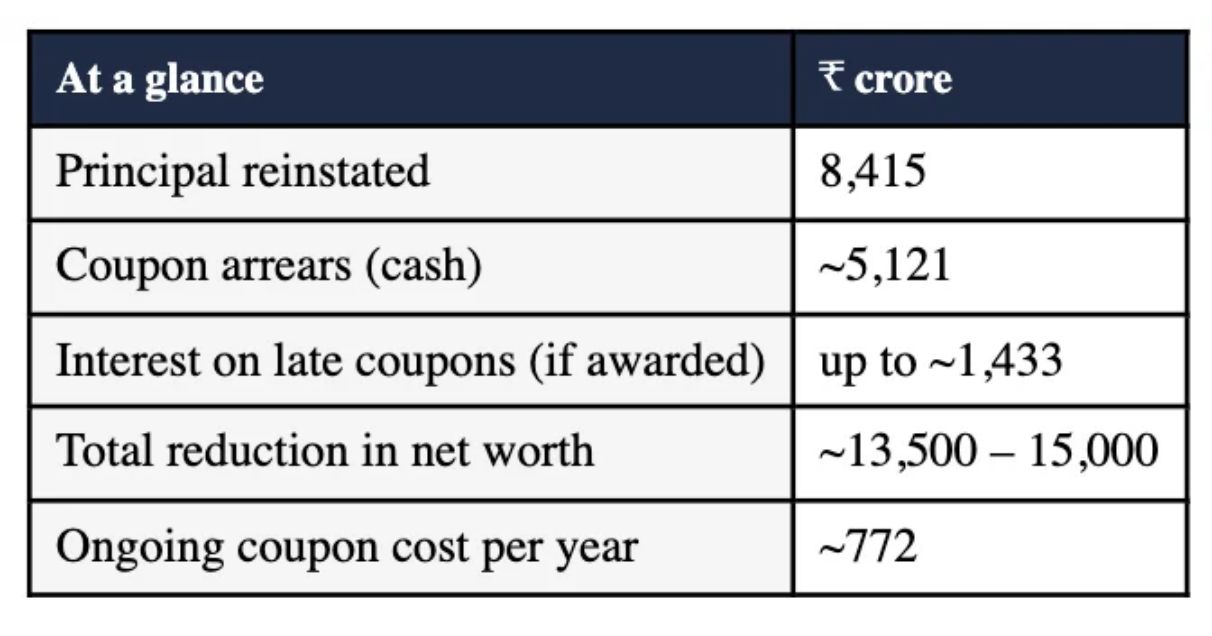
15-10-2026On 15 October 2026 the Supreme Court upheld the quashing of Yes Bank’s March 2020 write-down of ₹8,415 crore of Additional Tier-1 (AT-1) bonds and directed that coupons be paid in terms of the bonds’ Information Memoranda. We estimate the cost to Yes Bank at about ₹13,500 crore, rising to about ₹15,000 crore if interest on late coupons is awarded. The bank remains adequately capitalised, but its core capital ratio falls from 14.0% to about 10%.
During Yes Bank’s 2020 rescue, the bank’s Administrator wrote down two series of AT-1 bonds a day after the reconstruction scheme took effect. The Supreme Court held that the write-down was unlawful: the Government had deliberately removed the write-down clause from the final scheme, any write-down had to happen before the scheme took effect, and the power belonged to the Reserve Bank of India, which did not use it.
Two consequences follow. The bonds are treated as never validly written down, so they return to Yes Bank’s balance sheet. And the Court directed that ‘the payment of annual coupon rate … must be made in terms of the Information Memoranda’, so the coupons missed since 2020 are payable.
2. The Components
Principal – ₹8,415 crore
The bonds are perpetual, so no principal is payable in cash now. Cash would be needed only if Yes Bank redeemed them, which requires RBI approval. Reinstatement nonetheless moves ₹8,415 crore from shareholders’ equity back to liabilities.
Coupon arrears – about ₹5,121 crore
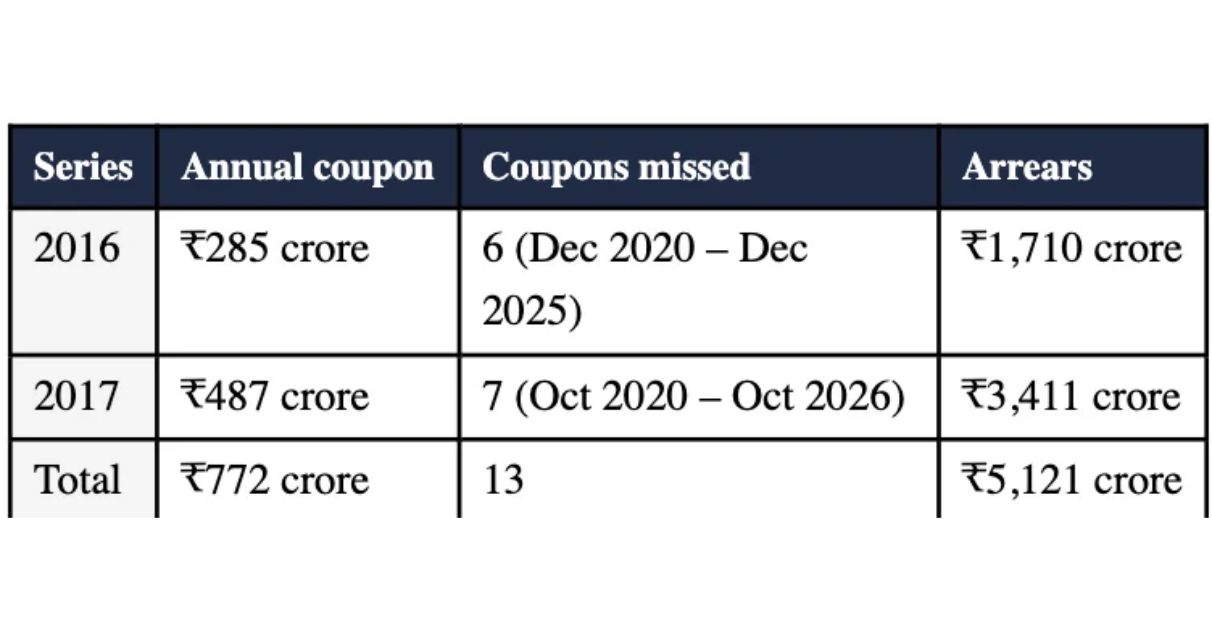 This is the immediate cash cost. A further coupon of ₹285 crore on the 2016 series falls due in December 2026.
Interest on late coupons – up to about ₹1,433 crore
The Court did not order interest. Bondholders may claim it; at a simple 9% from each missed date, it would amount to about ₹1,433 crore. Yes Bank can argue that the Court directed coupons only and that the write-down was under a court stay until now.
Ongoing cost – about ₹772 crore a year
Going forward, the reinstated bonds cost about ₹772 crore a year, roughly 18% of the bank’s current annualised profit of about ₹4,300 crore.
3. Impact on Capital
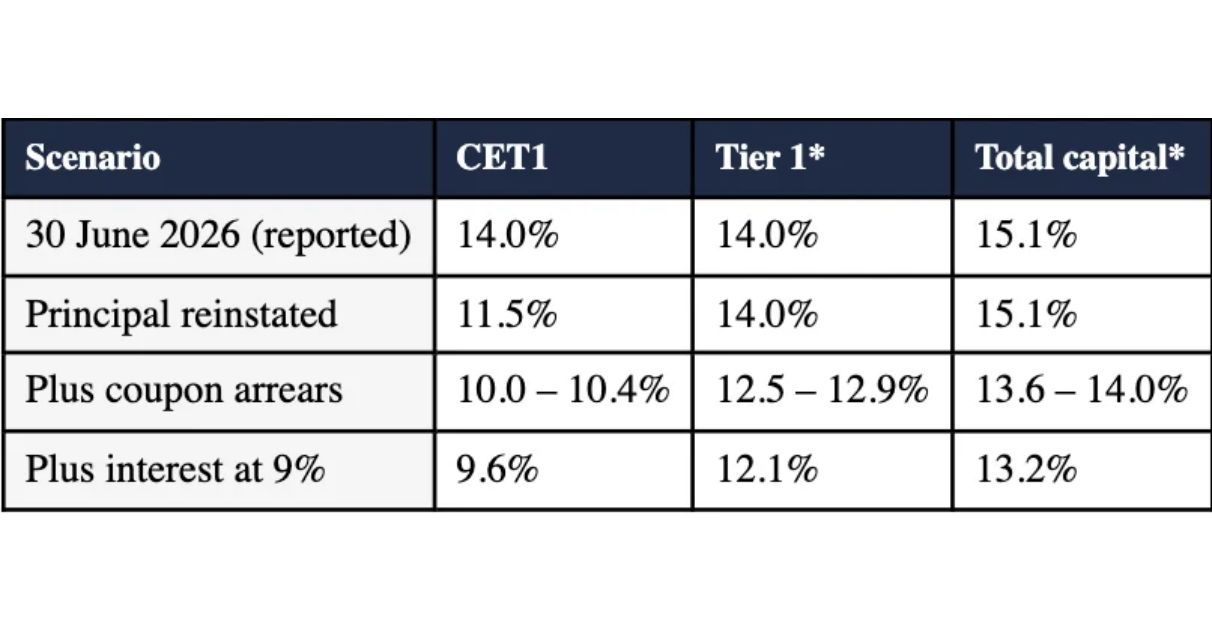 *If the RBI allows the reinstated bonds to count as AT-1 capital. Minimum CET1 including the conservation buffer is 8.0%.
Reinstating the principal mainly shifts capital from CET1 to AT-1; it is the coupon arrears that reduce total capital. In every scenario the bank stays above regulatory minimums, but its CET1 headroom narrows from about 6 percentage points to about 2. Book value per share falls from ₹16.7 to roughly ₹12.4–12.8.
4. Who Bears the Cost
The cost falls on Yes Bank’s shareholders, including SMBC, SBI, the other banks that joined the 2020 rescue, and public shareholders. On the day of the judgment the share price fell by as much as 20%, a loss in market value of the same order as our estimate. Yes Bank had earlier said it did not expect a material liability.
5. What Could Reduce the Burden
• Raising capital: the board has approved an enabling resolution for up to ₹16,000 crore, enough to cover the base case.
• Converting bonds into shares: in 2020 most bondholders were willing to convert. A negotiated conversion of principal and arrears would preserve cash.
• Redeeming and refinancing: with RBI approval, the bank could redeem the bonds and replace them with cheaper capital.
• Resisting interest: removing the interest claim keeps the cost near ₹13,500 crore.
• Tax: if the coupons are tax-deductible, the after-tax cost of the arrears falls to about ₹3,800 crore.
6. What to Watch
• Yes Bank’s disclosure of the impact to the stock exchanges and in its September-quarter results.
• Agreement or dispute with bondholders over the number of missed coupons and interest.
• The RBI’s decision on whether the reinstated bonds count as regulatory capital.

When the state wields a sledgehammer against citizens seeking accountability, the Supreme Court’s
Read More
At 46, Sanjay Gandhi’s son has already spent three terms in Parliament, written extensively on rur
Read More
More than 70 British parliamentarians have urged UN Secretary-General António Guterres to step up e
Read More