I. THE ARITHMETIC NOBODY IN DELHI WANTS TO READ ALOUD
In December 2024, the Finance Minister told Parliament that public sector banks had recovered Rs 14,131.60 crore from assets attached in the Vijay Mallya matter. That figure is not a defence brief. It is not a tweet. It is the Government of India's own number, given to the House, and it has never been withdrawn.
Set it against the other official number. In January 2017, the Debt Recovery Tribunal at Bengaluru adjudged the Kingfisher Airlines debt at Rs 6,203 crore, a figure that already carried some Rs 1,200 crore of interest inside it. That is the judgment debt. That is what a tribunal of competent jurisdiction, after years of hearings, said was owed.
Divide one by the other. The State has taken roughly two and a quarter times the sum a court said was due, and it continues to describe the man it took it from as an economic offender, a cheat and a fugitive from justice. In the Bombay High Court on 12 August 2026, senior advocate Amit Desai put the realisation at around Rs 15,000 crore against an original claim of Rs 6,203-odd crore. The court, entirely properly, said the figure would have to be confirmed by the respondents.
Here is the uncomfortable part: if the respondents confirm it, the case for continued criminal prosecution does not become weaker. It becomes something closer to incoherent.
Recovery in excess of the decree is not a technicality. In every other corner of Indian law, a decree-holder who realises more than the decree returns the surplus to the judgment-debtor. That is not mercy. That is the ordinary operation of Order XXI of the Code of Civil Procedure and of Section 8(8) of the Prevention of Money Laundering Act, which contemplates restoration of property to claimants with a legitimate interest. Nobody in this matter has yet explained, on any public record, where the surplus sits, who holds it, or on what legal basis it continues to be held.
II. RS 5,100 CRORE BOUGHT A CLEAN CHIT. RS 14,131 CRORE BOUGHT NOTHING.
On 19 November 2025, a Bench of the Supreme Court headed by Justice J.K. Maheshwari accepted a settlement proposal from Nitin and Chetan Sandesara, the promoters of Sterling Biotech, and their chartered accountant. They would deposit Rs 5,100 crore in the court's registry. In exchange, the Court exercised its power under Article 142 of the Constitution to quash every pending proceeding against them.
Not some proceedings. Every proceeding. Cases under the Prevention of Corruption Act. Cases under the Prevention of Money Laundering Act. Cases under the Fugitive Economic Offenders Act. Cases under the Black Money Act, the Companies Act and the income tax statutes. The deposit was completed in December 2025. On 13 April 2026, the last surviving criminal complaint, filed by SEBI, was compounded on the tender of a demand draft for Rs 45.70 lakh, and the matter was closed.
Recall who the Sandesaras were on the file before that order. Sterling Biotech had borrowed over Rs 8,100 crore from a consortium led by Andhra Bank. The CBI's FIR alleged fraud of about Rs 5,383 crore. The Enforcement Directorate attached roughly Rs 9,700 crore in Indian and overseas assets and filed chargesheets naming seven individuals and 184 companies. The brothers left India in 2017, reportedly travelling on Albanian passports. They were declared fugitive economic offenders in September 2020. Their case file was, by any measure available to a newspaper reader, at least as grave as the Kingfisher file and arguably a great deal graver, because it involved allegations of bribery of public servants that the Kingfisher file has never contained.
The comparison the State has never had to answer in open court
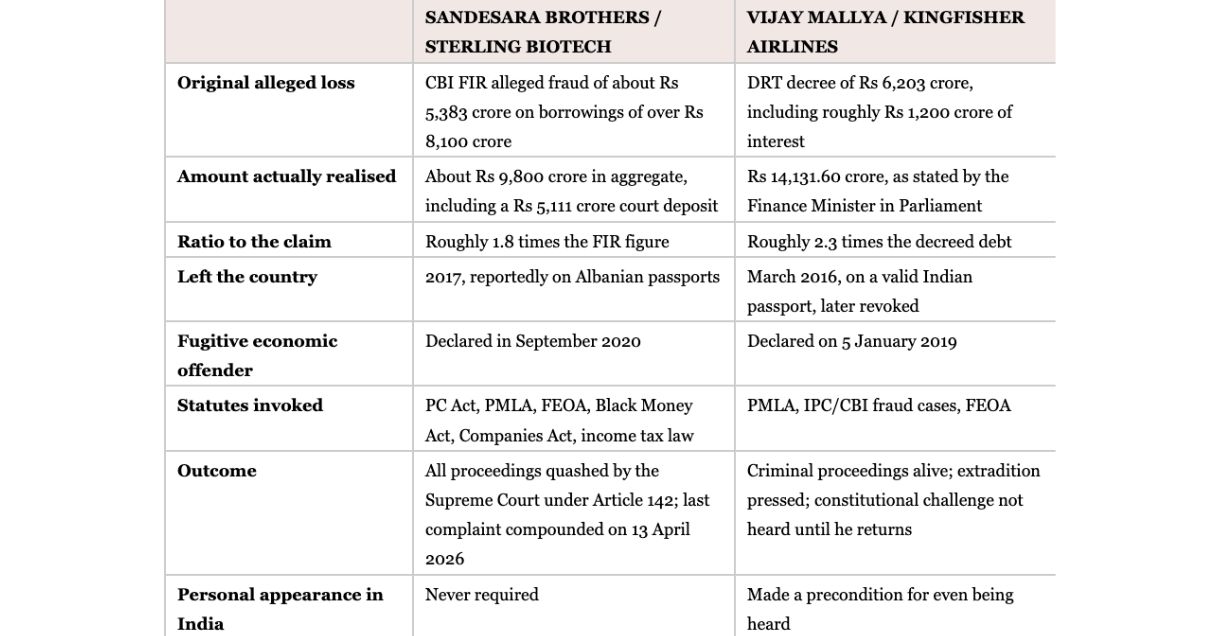
Figures as reported in the Supreme Court's orders, in parliamentary answers and in contemporaneous press accounts.
Read the last two rows together and the asymmetry stops being a matter of degree. One set of absconders was never asked to board a plane. The other is told, from the Bench, that he will not be heard at all until he does.
III. SAME AGENCIES. SAME STATUTES. OPPOSITE ANSWERS.
This is the part that deserves a straight question rather than a rhetorical one. The Enforcement Directorate that attached Rs 9,700 crore of Sterling Biotech assets is the same Enforcement Directorate that attached the Kingfisher and United Breweries holdings. The Solicitor General who placed the Rs 5,100 crore sealed-cover proposal before the Supreme Court in the Sandesara matter is the same Solicitor General who has told the Bombay High Court that Vijay Mallya has been absconding since 2 March 2016 and must return before he is heard. The Fugitive Economic Offenders Act applied to both sets of men. The Prevention of Money Laundering Act applied to both.
In one file, the Union's position was that a negotiated number, arrived at in a sealed cover and never published, was an acceptable substitute for trial across six statutes. In the other, the Union's position is that the recovery of more than twice the decreed debt does not even soften the demand for extradition and prosecution.
Both positions may be individually defensible. They cannot both be defensible at the same time, taken by the same law officers, in the same term of the same court.
A state that prosecutes selectively is not merely inefficient. It converts the criminal law into a bargaining instrument whose price is set case by case, behind closed doors, with no published tariff. Article 14 of the Constitution does not guarantee that the guilty will be punished. It guarantees that likes will be treated alike.
IV. THE DOCTRINE THE COURT QUIETLY CONTRADICTED
Eight days before the Sandesara closure, on 11 November 2025, a different Bench of the same court decided CBI v. Sarvodaya Highways. The Punjab and Haryana High Court had quashed criminal proceedings on the strength of a one-time settlement, worth about Rs 41 crore against a liability of roughly Rs 52 crore. Justices Vikram Nath and Sandeep Mehta restored the prosecution. Following Gian Singh (2012) and Vikram Anantrai Doshi (2014), they held what Indian courts have held for a decade and more: economic offences are wrongs against society, and an offence against the public exchequer cannot be extinguished by a private composition with a bank.
The smaller fraud, settled at nearly eighty per cent of the liability, went back to trial. The larger fraud, settled at roughly a quarter of what the lenders themselves told the Supreme Court they were owed, went home. There has been no public reconciliation of the two.
The three most powerful words in Indian jurisprudence: 'not a precedent'
The Sandesara Bench added the standard caveat. Its directions were issued in the peculiar facts of that case and were not to be treated as precedent. The caveat is meant to contain the damage. In practice it does something stranger: it creates a right that exists for exactly one set of litigants and is then formally withdrawn from everyone else.
An empirical study from IIM Ahmedabad, examining 1,579 cases, found the practice of stamping orders as non-precedential to be applied with striking irregularity. And the containment has already failed on its own terms. In March 2026, Anil Ambani moved the Supreme Court seeking debt resolution, in substance, like the Sandesara case. The door cannot be held open for one litigant and declared shut in the same breath.
If the Sandesara order is good law, Vijay Mallya is entitled to invoke it. If it is not good law, the country is owed an explanation of how it came to be passed, and the Sandesaras are the ones with an anomaly to justify. What cannot survive scrutiny is the middle position currently occupied by the State: that the order was correct, that it binds nobody, and that no one may ask why.
V. THE BUSINESS FAILURE THE STATE INSISTS ON CALLING A THEFT
Strip away the peacock imagery and the yacht photographs, and the Kingfisher file is a story about an airline that died in a fuel-price and tariff environment that killed several of its contemporaries. The airline was a guarantor-backed corporate borrower. The loans were sanctioned by professional credit committees at state-owned banks after their own due diligence, against security including brand valuations those banks themselves accepted.
Before the Bombay High Court in August 2026, the applicant's case included a submission that the Reserve Bank of India's own audit of the accounts characterised the collapse as a business failure. That submission has not been tested and may be contested. But it points at the question the criminal law is supposed to answer and has not yet answered in eleven years: was there dishonest intention at the moment of borrowing, or was there a commercial catastrophe followed by an inability to pay?
Those are different things. Indian law knows they are different things. Section 25 of the Indian Contract Act, Section 138 of the Negotiable Instruments Act and the entire architecture of the Insolvency and Bankruptcy Code exist because the Republic long ago decided that failing to repay is not, by itself, a crime. A personal guarantee is a civil instrument. Enforcing it is a civil remedy. What converts default into fraud is proof of a dishonest intention, and proof of a dishonest intention requires a trial.
Eleven years on, there has been no trial, but there has been a full recovery, and then some. The State has obtained the entire practical benefit of a conviction without ever having to prove one.
VI. HEADS YOU LOSE, TAILS YOU LOSE: THE CATCH-22 IN THE FEO ACT
On 12 February 2026, a Division Bench of the Bombay High Court told Mallya's counsel, in terms, that he must come back or his petition could not be heard. The Bench was applying a respectable principle: a litigant who evades the court's process cannot ask for its equitable assistance.
Now look at the trap that principle creates when it meets this statute. Mallya's petitions challenge the constitutional validity of the Fugitive Economic Offenders Act, 2018, and the order declaring him a fugitive economic offender under it. His counsel's argument is that the Act itself provides that on appearance in India the declaration falls away, which would render the constitutional challenge infructuous the moment he lands. Challenge it from abroad and you are told you have no standing to be heard. Challenge it from India and you have nothing left to challenge. The vires of a statute that has already been used to confiscate property become, in effect, unexaminable.
Add the practical fact placed on record in February 2026: his Indian passport was revoked in 2016, which is why he told the court he could not give a date of return. The State cancels the document required to comply, then treats non-compliance as proof of contumacy.
There is a further oddity. The Fugitive Economic Offenders Act was enacted in 2018 to compel the return of absconders by confiscating their property. In this case the property has been confiscated, sold and applied. The statute's coercive purpose has been exhausted. What remains is a label, and a label is not a remedy.
VII. RECOVERY FIRST, ADJUDICATION MAYBE, RESTITUTION NEVER
Consider what has actually happened to the assets. Shares of United Breweries attached by the Enforcement Directorate were transferred, on the direction of the special PMLA court in Mumbai, to the recovery machinery of the Debt Recovery Tribunal and sold. Reported tranches run into thousands of crores. Some Rs 350 crore from the attached assets was applied, on the record, to the unpaid dues of Kingfisher Airlines employees, which is a genuinely good outcome and one that ought to be said plainly.
But note the sequence. Attachment, confiscation, sale and distribution have all been completed. Trial has not begun. In an ordinary criminal proceeding the sequence runs the other way, and for a reason: the presumption of innocence means the State should not take irreversible action against property before it proves its case.
Under the PMLA model, the State can. And once shares are sold to third parties in the open market, restitution is not a remedy that exists in any meaningful sense. An acquittal eleven years from now would be an academic event. The applicant would receive a judgment and, at best, a claim to a cash surplus that nobody has yet acknowledged holding.
What the file of 12 August 2026 actually shows
The order that prompted this essay is short and, read closely, quietly damning. Justice Milind N. Jadhav records that Criminal Application No. 148 of 2020 came up for the first time on 12 August 2026, six and a half years after it was filed, and only because the Board Department had been directed to list old shelf matters. Notice had never been issued. The Court noted that the applicant had also not moved the matter.
Then read paragraph 8 of the same order. Counsel for the State Bank of India asked the Registry for copies of the court papers because the bank's own papers were missing, and no appearance was entered by the advocate for SBI.
A lender that told the country it had been defrauded of thousands of crores turned up to a hearing without its file and without entering an appearance. That is not the conduct of a victim pressing a grievance. It is the conduct of a party that considers the matter over.
The Court has now issued notice to SBI as lead bank and to the Deputy Director of the Enforcement Directorate, specifically to be told whether the recoveries and the settlement are, in the Court's phrase, done and dusted. Notice was made returnable on 9 September 2026. That is the right question, asked at last, by the right forum.
VIII. TWO INDIAS OF INSOLVENCY
Sucheta Dalal has described the emerging landscape as two Indias of insolvency: one in which small borrowers face the full rigour of the recovery statutes, and another in which very large defaulters obtain judicially mediated pardons. The Sandesara order is the clearest artefact of the second India. The Mallya file is the clearest artefact of what happens when a defaulter becomes, for reasons that have more to do with television than with law, the face of the first.
It matters that the Kingfisher collapse arrived at a particular political moment and produced a particular political usefulness. A named villain is worth a great deal to a state that must otherwise explain how public sector banks accumulated lakhs of crores of stressed assets through the same decade. That explanation was never given, because it did not have to be. There was a man in London with a moustache and a Formula One team, and the story told itself.
None of this makes Vijay Mallya sympathetic, and this essay does not need him to be. The argument does not depend on his character. It depends on a proposition that applies to everyone: the criminal law should not be the instrument by which the State recovers money it has already recovered, and a settlement framework available to one set of promoters cannot be withheld from another on the basis that the public dislikes them more.
IX. WHAT EQUAL TREATMENT WOULD ACTUALLY REQUIRE
• An audited, public statement of account. The ED and the SBI-led consortium should place before the Bombay High Court a line-by-line reconciliation: what was attached, what was realised, what was applied to the decree, and what surplus is held and by whom. The Court asked for exactly this on 12 August 2026.
• Restitution of any surplus, or a reasoned explanation of why it is lawfully retained. If more than the decree has been recovered, the excess belongs to the judgment-debtor unless a statute says otherwise. If a statute says otherwise, it should be cited.
• A published settlement policy for economic offences. If the State is willing to compound cases of this magnitude, Parliament should write the rules, fix the multiple of the loss, and apply them uniformly, instead of leaving the outcome to a sealed cover and Article 142.
• Reconciliation of Sandesara with Sarvodaya Highways. A larger Bench should settle whether economic offences can be extinguished by payment, because at present the answer depends entirely on which court you reach.
• A remedy for constitutional challenges to the FEO Act that does not require the challenger to first destroy his own cause of action.
• Prompt trial or closure. Eleven years of pre-trial confiscation without adjudication is not a prosecution. It is a sentence imposed without a verdict.
�
X. THE CASE AGAINST EVERYTHING ARGUED ABOVE
A serious argument has to survive its own rebuttal. Here is the strongest version of the other side, stated without hedging.
The recovery figure is not the whole liability
The Rs 6,203 crore decree dates from January 2017 and carries interest at 11.5 per cent per annum from the date the banks filed. Compounded over nearly a decade, the true outstanding is far larger than the decretal figure, and the recovery may not represent a surplus at all. The consortium has never conceded that it has been overpaid. In the Sandesara matter, the lenders told the Supreme Court their total dues were Rs 19,283.77 crore against the Rs 9,800 crore realised, which suggests the same gap between headline recovery and actual loss. The arithmetic in Section I is the applicant's arithmetic, not an audited one, and the Bombay High Court was right to say so.
Criminal liability does not evaporate on repayment
This is settled law and it is good law. If money laundering, criminal conspiracy or cheating occurred, the offence is complete when it is committed. A thief who returns the goods is still a thief. Gian Singh and Vikram Anantrai Doshi hold that offences against the public exchequer are not private disputes to be bought off, and Sarvodaya Highways restated that principle as recently as November 2025. On this view the anomaly in Indian law is the Sandesara order, not the continued prosecution of Vijay Mallya, and the correct response is to narrow the former rather than extend it.
The allegations are about diversion, not default
The ED's case has never been that Kingfisher failed to repay. It is that a substantial portion of the sanctioned funds, put by the agency at around Rs 3,500 crore of roughly Rs 9,000 crore, was routed out of the airline through group entities and offshore structures for purposes unconnected with the airline's operations. If proved, that is not a business failure. It is a fraud on the lenders and on the public that owns them. The RBI-audit characterisation relied on by the applicant is a submission of counsel, not a finding.
He left, and that choice has consequences
He departed India on 2 March 2016, as banks were closing in, and has not returned in over a decade. A UK court ordered his extradition; the Home Secretary signed it in February 2019; it remains unexecuted because of proceedings he initiated. A litigant who selects his forum from abroad and declines to submit to the jurisdiction he is asking for relief from is not similarly situated to one who appears. The Bombay High Court's insistence on return is not a trap; it is the ordinary rule that the courts are not a service available remotely to those avoiding them. The Sandesaras' treatment does not create an entitlement in others.
Selective enforcement is not, by itself, a defence
Indian courts have repeatedly held that a person cannot claim the benefit of an illegality or an anomaly granted to someone else. There is no negative equality under Article 14. Even if the Sandesara order was wrongly passed, that is an argument for correcting it, not for replicating it. And the Sandesara Bench said in terms that its directions were confined to the peculiar facts and were not to be treated as precedent.
The wider cost
A published tariff for buying out economic offences would be a disaster for credit discipline. It would tell every large promoter that diversion of bank funds carries a known, survivable price, payable years later out of the assets the diversion helped build. The small borrower, who has no access to Article 142 or to senior counsel, would go on facing the full rigour of the same statutes. That is precisely the two-India problem, and extending the bargain upward does not solve it. Closing it does.
What remains, after both cases are put, is not a conclusion about guilt. It is a narrower and more awkward finding: that the Republic currently has two different answers to the same question, that it has never explained the difference, and that on 9 September 2026 a judge of the Bombay High Court has, at last, required someone to try.
Sources and status
Order of the Bombay High Court dated 12 August 2026 in Criminal Application No. 148 of 2020 with Criminal Application No. 1186 of 2021 and Interim Application No. 197 of 2022, Justice Milind N. Jadhav, made returnable 9 September 2026. Supreme Court orders of 19 November 2025 and 13 April 2026 in the Sterling Biotech matter. CBI v. Sarvodaya Highways, decided 11 November 2025. Parliamentary answer of December 2024 on recoveries from attached assets. Bombay High Court proceedings of 12 and 18 February 2026 on the Fugitive Economic Offenders Act challenge. Contemporaneous reporting in Indian Express, Business Standard, Bar and Bench, LiveLaw, Moneylife and Supreme Court Observer.
This is an opinion piece, written to state one side of a live controversy as strongly as the record permits, with the opposing case set out in Section X. Figures attributed to counsel are submissions, not findings. Matters listed for 9 September 2026 may have moved since.
An argumentative essay. Written from the applicant's side of the record, using figures placed on the record by the Government of India, the Enforcement Directorate, the Supreme Court and the Bombay High Court. A section at the end sets out the case against everything argued here.