We are reminded of our colonial past every year on August 15. As we prepare to celebrate our next independence day, this article tries to ask a critical question related to this historical date celebrated nationally every year. Was this famously celebrated midnight tryst with destiny the actual moment when India attained full political freedom, or was it merely a ceremonial hand‑off leaving the transfer of full political sovereignty to a later date when it was actually in the British interests to do so? Re‑examining that assumption is essential to understanding what ‘independence’ actually means in a constitutional democracy.
The distinction between ‘dominion status’ and ‘full constitutional sovereignty’ is of more than just academic interest. It is the key to determine the point of time when the relationship between citizens and state came to be governed by the Constitution. Prior to this point, the relationship was governed by the Government of India Act, 1935 and later additionally by the Indian Independence Act, 1947.
Dr. Aman M. Hingorani, in his magisterial work Unravelling the Kashmir Knot, draws a careful distinction between self‑rule, dominion status, and full internal sovereignty. From 15 August to 26 January 1950, India existed as a Dominion within the British Commonwealth. George VI remained its head of state, with a Governor‑General acting as his representative. The Indian Army's operational command and control was not in hands of Indian leaders. During this period the Crown formally retained sovereignty. Both Dr. Hingorani and Narinder Singh Sarila (In The Shadow of the Great Game) mention a coup staged by British troops during this time in Gilgit region by hoisting Pakistani flag and declaring allegiance to it, while legally they had no authority to do it. But was India truly independent in the same sense as it became after November 26, 1949? Who had the control of our armed forces on August 15, 1947? Who did the Gilgit Scouts betray when they hoisted Pakistani flags? They were serving, and were commanded, on either side, by the British at all times. The strategy they were implementing was British. And the officers of Gilgit Scouts? They were all British too.
A nation that does not have full civilian control over its armed forces is not a fully independent nation. Both authors note that Indian military commanders had drawn up definite plans to recover POK from the grip of occupying Pakistani forces. But the civilian control was not in Indian hands. It is therefore not surprising that those plans were never considered. British never wanted India to get control of POK back. It would have been a serious impediment to their post WW-II plans carefully drawn up by Churchill’s War Cabinet. By November 26, 1949 it was safe for this control to be fully transferred to Indian hands. January 26 was then selected for historical reasons. India did not achieve true independence, marked by republican constitutionality, until November 26, 1949.
Why does 15 August command such historical importance? Was there ever any Indian involvement in selecting this date? It was selected by Mountbatten because it coincided with the second anniversary of Japan’s surrender after WW-II. It was a moment freighted with meaning for Allied victory and the atomic bombing of Hiroshima and Nagasaki. Mountbatten himself admitted this in later interviews, as documented by Dr. Hingorani.
August 15, in truth, is an Allied military anniversary, entangling us with South Korea. August 15 is celebrated in South Korea as Gwangbokjeol, the “Restoration of Light” after Japanese colonial rule. It is remembered in Japan as the day the Emperor’s famous surrender broadcast ended fifteen years of militarist expansion. It is well known that the southern coastal regions of Indian homeland were under attack by the Japanese fleet. Netaji’s Indian National Army strategy relied strongly on a Japanese victory. Netaji’s strategy ultimately succeeded in uniting the Indian sailors in the British Navy to mutiny. This played its part in convincing the British that the safe thing to do is to leave. Ultimately, India’s independence story is neither about Japanese surrender in WW-II nor Korean liberation. Should the music of our most important civic festival be marred by the beat of these old battle drums?
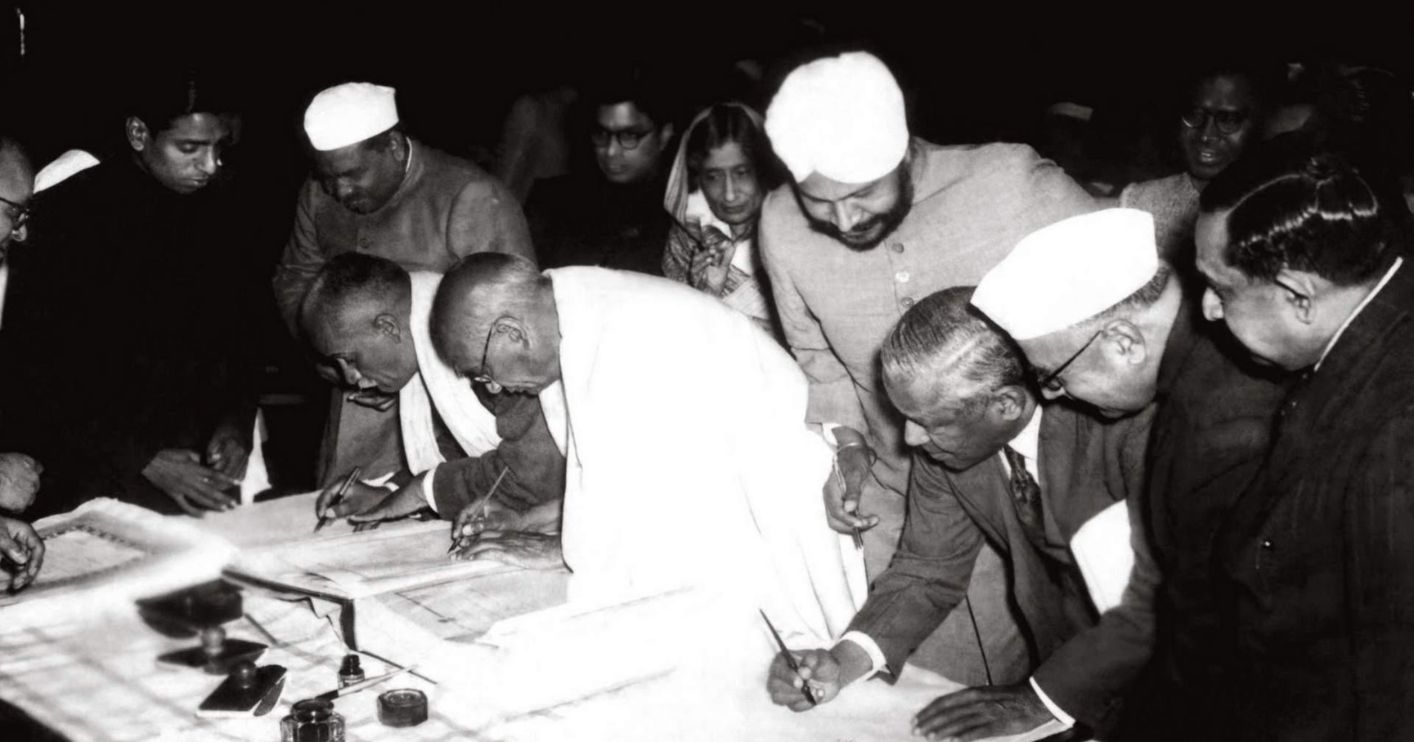
A more persuasive candidate is 26 November 1949, when the Constituent Assembly adopted the Constitution of India. That moment consummated a transfer of sovereignty not merely from one set of rulers to another, but from rulers to the rule of law. On that date India declared, in effect, that its legitimacy would flow henceforth from “We, the people,” not from the Crown, the viceroy, or even the wartime exploits of nationalist leaders.
Yet 26 November languishes in the calendar as “Constitution Day,” overshadowed by two splashier occasions: Independence Day in August and Republic Day on 26 January. In truth these three dates capture successive stages of freedom: the ceremonial exit of the British, the formal adoption of the Constitution, and its coming into force. Elevating 26 November to parity with 15 August would not erase history but clarify it, placing each milestone in its proper sequence.
What would change if India began to celebrate “Dominion Day” on 15 August and “Independence Day” on 26 November? First, it would sharpen public understanding of how state power is lawfully constituted. Second, it would invite citizens to reflect on what sovereignty requires of them beyond flag‑hoisting: fidelity to a constitutional culture that protects liberty, dignity, and the equal worth of every person. Third, it would release Independence Day from the colonial shadow of Mountbatten’s timetable and recast it as a celebration of Indian authorship.
The idea is hardly without precedent. Canada observes Dominion Day (now Canada Day) to mark the enactment of its British North America Act, not the departure of British troops. The United States honors 4 July, the date of its Declaration of Independence, even though the Revolutionary War continued for years thereafter. Nations choose the day that best tells their own story, not someone else’s.
None of this diminishes the heroism of the freedom struggle or the emotional charge of 15 August. It simply asks whether our public rituals should rest on the facts as they were, not as we have been conditioned to remember them. In a republic that aspires to be governed by truth and reason, historical accuracy is not pedantry; it is national service.
As the next anniversary of Dominion Day approaches, the invitation is open: let scholars, journalists, and citizens debate whether 26 November should become the day we celebrate our true Independence? Such a conversation would honor the Constitution far more than rote slogans ever could. Nations, like individuals, mature when they are willing to see historical facts just as they were, without the lens of any ideology. Perhaps it is time for India to take that mature step.
- Author is a professor of law at Jindal Global Law School