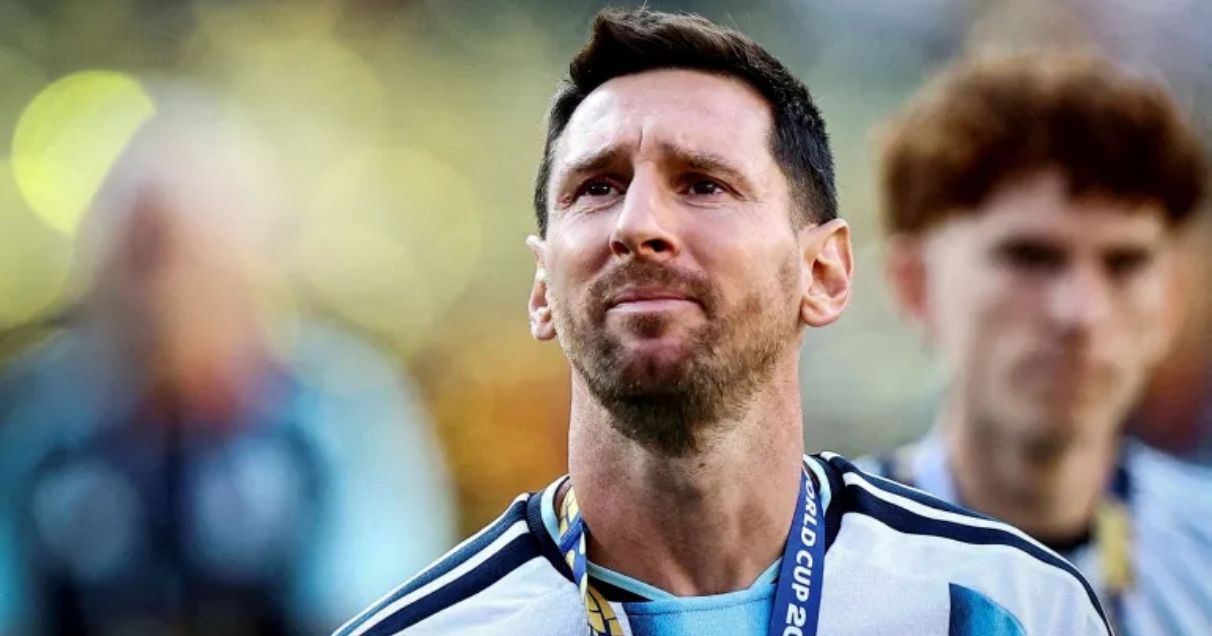
There will be no seventh World Cup. No another comeback. And no more Lionel Messi walking onto the field wearing Argentina's blue and white.
After two extraordinary decades, Messi has called time on his international career.
The 39-year-old Argentine superstar announced his retirement on Monday, bringing down the curtain on a national-team journey that began with an 18-year-old prodigy in 2005 and ends with Messi as a World Cup-winning captain, Argentina's record goalscorer and its most-capped footballer.
The decision comes following Argentina's defeat to Spain in the World Cup final and amid an intensely personal period for Messi following the death of his father earlier this month.
Messi disclosed that his retirement message had actually been written on July 21, two days after the final. The subsequent loss of his father, he indicated, only strengthened his conviction that the time had arrived to walk away.
And this time, unlike 2016, the farewell appears final.
'I have nothing more left to give'
Messi's message was emotional but remarkably settled.
He acknowledged the pain involved in giving up the Argentina shirt and reflected on having given everything he could to the national team — not merely during the triumphant final years of his international career, but also throughout the long period when trophies repeatedly escaped him.
There was also an unmistakable passing-of-the-torch message.
Messi believes Argentina possesses an outstanding generation of younger players who now deserve their opportunity.
He leaves, he said, with peace and pride over what he and his teammates ultimately managed to achieve.
Messi also thanked his family, supporters, teammates, coaches and officials who accompanied him through the extraordinary journey.
He may no longer be on the pitch for Argentina, but Messi made clear that he isn't leaving the team emotionally. He will now watch as another supporter, celebrating its victories and standing behind it during difficult times.
Club football, meanwhile, continues. Messi remains with Inter Miami in Major League Soccer.
A teenager who became Argentina's No. 1
The statistics alone place Messi in territory unlikely to be occupied by another Argentine footballer for years.
207 international appearances.
125 goals.
Six World Cups.
And, most importantly, one World Cup trophy.
Messi made his senior Argentina debut in 2005 at just 18.
By the following year, he was already at the World Cup in Germany.
He scored against Serbia and Montenegro during the 2006 tournament and announced himself on football's greatest international stage as one of Argentina's most exciting young talents.
What followed was not, however, the straightforward coronation many expected.
For years, Messi's Argentina career was haunted by one question: Why couldn't a footballer who won virtually everything at club level do the same for his country?
The defeats that nearly broke him
Argentina's 2010 World Cup challenge ended in the quarter-finals.
Then came Brazil in 2014.
Messi took Argentina all the way to the World Cup final, only for Germany to deny them the trophy.
He had come within touching distance of football immortality — and lost.
The heartbreak continued.
Argentina subsequently suffered Copa America final defeats against Chile. After another painful loss in 2016, Messi decided he had endured enough.
He announced his international retirement.
For a brief period, it seemed entirely possible that the greatest Argentine footballer since Diego Maradona would finish his international career without a major senior trophy.
Then Messi reconsidered.
It proved to be one of the most consequential U-turns in football history.
The comeback changed everything
Messi returned to Argentina.
The failures continued for a while, but so did the pursuit.
Finally, in 2021, the breakthrough arrived.
Argentina defeated Brazil at the Maracana to win the Copa America.
For Messi, the significance went far beyond another medal.
After years of criticism, lost finals and questions about whether he could reproduce his club success in an Argentina shirt, he finally had his major international trophy.
Messi had been instrumental throughout the competition, contributing either a goal or an assist to nine of Argentina's 12 goals.
But there remained one unfinished piece of business.
The World Cup.
Qatar changed Messi's legacy forever
If 2021 brought relief, Qatar 2022 brought immortality.
Messi arrived at the World Cup knowing it could represent his final realistic opportunity to win football's greatest prize.
He responded with one of the defining tournaments of his career.
Argentina reached the final against France.
What followed was an extraordinary contest.
Messi scored twice as the match finished 3-3 after extra time. Argentina then prevailed in the penalty shootout.
Messi finally lifted the World Cup.
He scored seven goals and provided three assists during the tournament and was awarded the Golden Ball as its outstanding player.
For millions of Argentines, the debate was over.
Messi had done it.
The boy who had left Argentina for Barcelona, carried the burden of comparisons with Maradona, endured defeat after defeat and even retired once had returned to lead his country to the summit of world football.
Six World Cups later, the No. 10 walks away
Messi's World Cup journey eventually stretched across six tournaments — 2006, 2010, 2014, 2018, 2022 and 2026.
He accumulated 34 World Cup appearances, 21 goals and 12 assists, playing more than 3,000 minutes on football's biggest international stage.
Yet numbers cannot fully describe his relationship with Argentina.
It was complicated.
Messi was worshipped, questioned, criticised, defended and eventually adored with an intensity reserved for very few athletes.
There was a time when his inability to win a senior international trophy threatened to become the defining qualification attached to his greatness.
By the time he walked away, that qualification had disappeared.
Copa America champion.
World champion.
Record goalscorer.
Record appearance-maker.
Six-time World Cup participant.
And captain of one of Argentina's greatest teams.
The teenager who first wore Argentina's senior shirt in 2005 leaves it 20 years later having experienced almost every emotion football can offer.
The defeats once made him walk away.
The victories brought him back to the summit.
And now, at 39, Lionel Messi has decided for himself that there is simply nothing left to chase.
Argentina will have another captain. It will have another No. 10. It will produce more great footballers. But there will only ever be one Lionel Messi.