The notices
came the way notices had always come. An envelope, or an email, from an officer with a name and a ward number, sitting in a building the assessee could have driven to. A demand to explain income from a year most people had stopped thinking about. In lakhs of cases between 2022 and 2025, across every state, this is how reassessment under the Income-tax Act began.
There was nothing unusual about any of it. That was the problem.
Five months before the first of those notices went out, the Central Board of Direct Taxes had published a rule saying they were not to be sent that way at all.
The promise
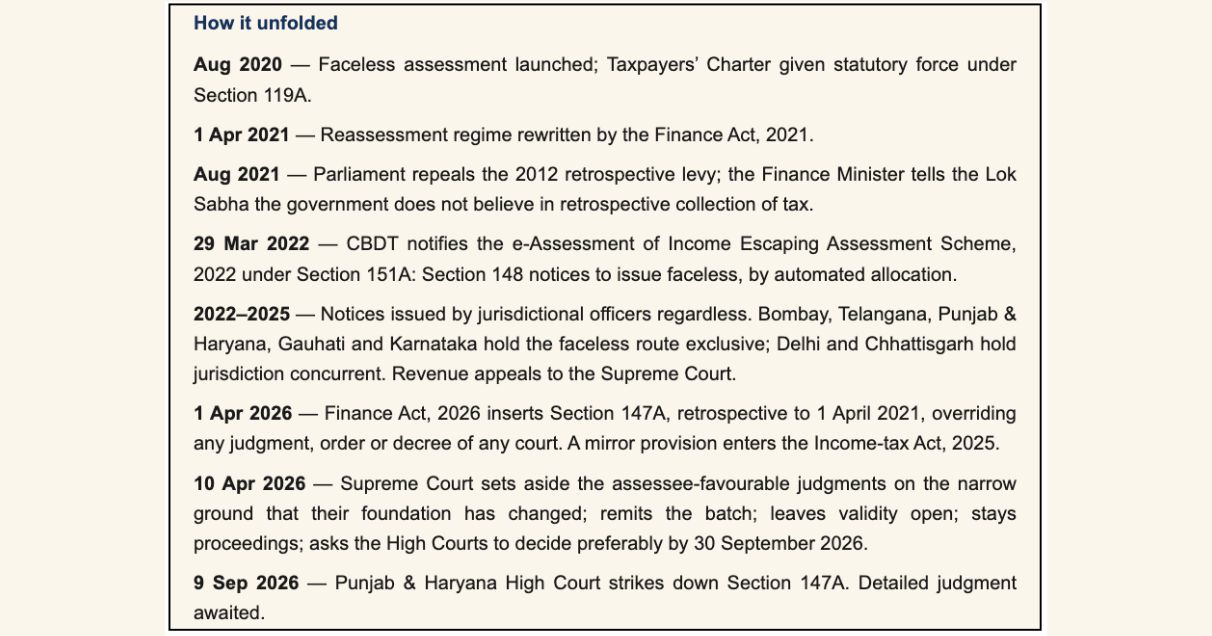
To understand why a Division Bench in Chandigarh struck down an Act of Parliament this week, you have to go back to a summer afternoon in August 2020, when the Prime Minister launched a platform called Transparent Taxation , Honouring the Honest.
The centrepiece was faceless assessment, and the pitch was not about speed or convenience. It was about character. The Indian tax officer, in the popular imagination and often enough in fact, was a person you met. The file sat on a particular desk in a particular city. Proximity created discretion, and discretion created everything that flowed from it. Faceless assessment was meant to engineer that away: cases allocated by machine, the officer unknown to the taxpayer and the taxpayer unknown to the officer, jurisdiction settled by an algorithm rather than a pin code.
It was, by any measure, the most ambitious thing an Indian tax administration had attempted in a generation. It was also, for a while, a genuine success. And in March 2022 the Board gave it teeth for the last part of the system still outside it — reassessment, the reopening of old years, historically the most abrasive point of contact between the state and a taxpayer.
Acting under Section 151A of the Act, the Board notified the e-Assessment of Income Escaping Assessment Scheme, 2022. Its terms were not ambiguous. Notices under Section 148 were to be issued through automated allocation, in a faceless manner. Section 151A required the scheme to be laid before both Houses of Parliament. This was not a circular or a press note. It was delegated legislation, written by the Department, binding on the Department.
The rule nobody used
And then the notices went out the old way.
Not once. Not in a stray charge where a server was down. As standard practice, nationally, for three years , signed by the Jurisdictional Assessing Officer, the named human being whose removal from the process was the entire point of the scheme that had just been notified.
Nobody has ever explained this satisfactorily. The most charitable reading is institutional inertia: the faceless centre was built for assessment, reassessment sat in the field formations, the field formations had targets, and pushing the work through a new channel was harder than doing what everyone had always done. The least charitable reading is that somebody in the hierarchy simply did not accept that reassessment should be taken away from the officer who knew the taxpayer.
Either way, the asymmetry is worth sitting with for a moment. If an assessee had filed a return in some manner other than the notified electronic mode, that return would have been treated as never filed. Not defective, non-existent. Nobody in the Department would have called it a question of form. The compliance standard the state applies to the citizen is exact, and applied without apology. The standard the state applied to itself here was that the officer who had always done this could carry on doing it.
The split
Taxpayers noticed, as taxpayers do. From 2023, writ petitions began to land, not arguing that the income had not escaped assessment, but that the letter had come from the wrong desk. In legal circles it acquired a shorthand: JAO versus FAO.
The Bombay High Court answered first and most fully, in Hexaware Technologies, and it answered against the Revenue: the faceless route was not one of two options, it was the route. Telangana followed. So did Gauhati, and Karnataka, and the Punjab & Haryana High Court itself, in Jatinder Singh Bhangu and then Tej Partap Singh. Thousands of notices fell.
But Delhi went the other way. In T.K.S. Builders and cases following it, the High Court held that jurisdiction was concurrent, the faceless centre could issue a notice, and so could the jurisdictional officer. Chhattisgarh took a similar view. And so, by 2025, the answer to whether a taxpayer’s reassessment was valid depended on which High Court happened to have territorial jurisdiction over the officer who had signed the letter. A company in Gurugram and a company in Delhi, identical facts, opposite outcomes.
That is exactly the situation the Supreme Court exists to resolve, and the Revenue had taken its appeals there. The country was one judgment away from an answer good in every state.
The clause
The answer never came, because on 1 February 2026 the Finance Bill intervened.
Clause by clause, budget documents are dry. This one was not. The Explanatory Memorandum recorded, openly and without embarrassment, that the High Courts had divided and that the matter was pending before the Supreme Court. Then it proposed Section 147A.
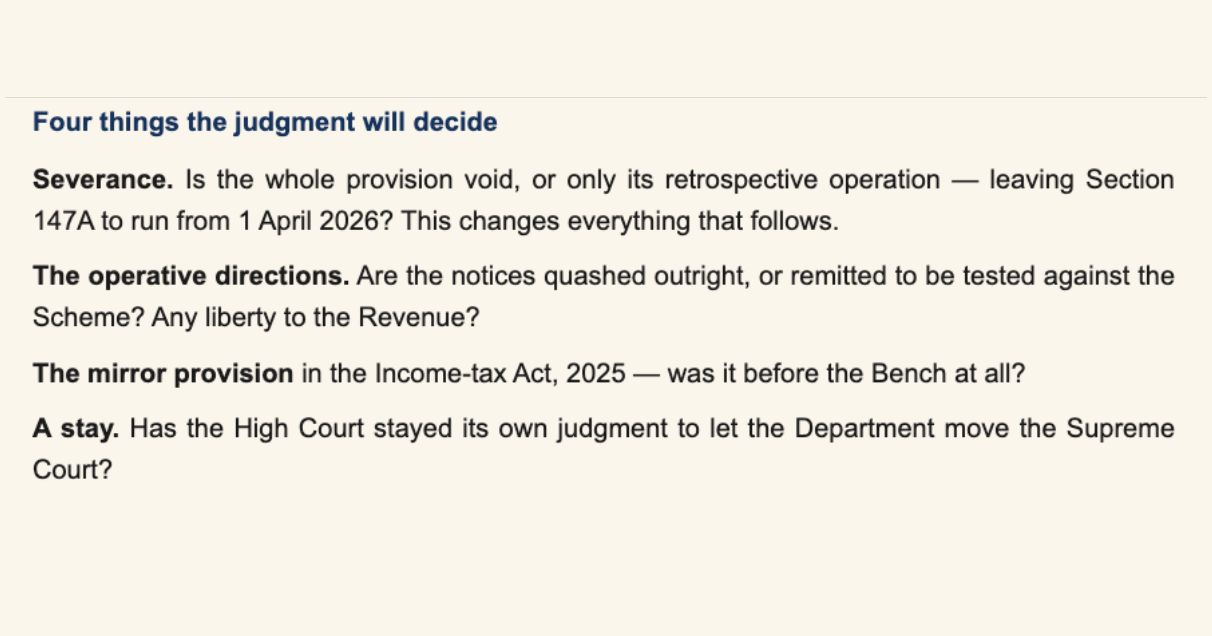
The provision became law on 1 April 2026 and was deemed to have been in force since 1 April 2021. It said that for the purposes of Sections 148 and 148A, the expression Assessing Officer means , and shall always be deemed to have meant, an officer other than the National Faceless Assessment Centre. It opened by overriding anything contained in any judgment, order or decree of any court, or in Section 151A, or in any scheme framed under it. It carried the customary recital that it was inserted for the removal of doubts. A mirror provision went into the new Income-tax Act, 2025, so that the dispute would survive the change of statute.
Read it slowly and the strangeness surfaces. Parliament did not repeal the faceless mandate. It did not amend Section 151A. It did not say automated allocation had never been required. The Scheme of 2022 is still on the statute book today, still requiring that reassessment notices issue faceless. What Parliament did was leave the whole architecture standing and lay a definition across the top of it that reverses the result.
There is a settled distinction here, and it is nearly sixty years old. In Shri Prithvi Cotton Mills, and again in Indian Aluminium, the Supreme Court held that a legislature may cure the defect a judgment identified, and by removing the basis of the judgment, remove the judgment’s effect. What it may not do is leave the basis intact and declare the judgment wrong. Section 147A removed nothing. It overruled.
And it did so while the Union’s own appeal was pending before the Supreme Court on that very question, which is a sentence worth reading twice, because everything that matters about this case is inside it.
Ten days in April
On 10 April 2026 the Supreme Court did what, in the circumstances, it almost had to do. A Bench headed by the Chief Justice set aside the High Court judgments that had gone in favour of assessees, not because they were wrong, but because the statutory foundation on which they rested had been changed underneath them while the appeals were being heard.
It was careful about what it was not deciding. Validity, scope, effect and retrospectivity of Section 147A were expressly left open. Assessees were given four weeks to amend their petitions to challenge the new provision, the Revenue three weeks to reply. Further assessment and reassessment were stayed while the challenges were pending. And the High Courts were asked to decide, preferably, by 30 September 2026.
So a question that had been one hearing away from a national answer was sent back to a dozen High Courts to be argued again, from the beginning, on a clock. That is the first cost of Section 147A, and it was entirely avoidable.
Chandigarh, Wednesday
The first High Court to reach the end of that road was the one where the question had started.
On 9 September a Division Bench of Justice Deepak Sibal and Justice Rupinderjit Chahal pronounced. Section 147A was struck down as unconstitutional. The detailed judgment has not yet been uploaded, so the reasoning is not public and the crucial question of severance, whether the whole provision falls, or only its retrospective operation, is still unanswered. The Economic Times reports that over two lakh taxpayers are touched by the issue.
The Department will appeal. It will file within days, and it will ask the Supreme Court to stay the operation of the judgment. It should get neither the stay nor, in the end, the relief.
What the Supreme Court is really being asked
Strip the tax out of this and a plain constitutional question is left standing.
May the Union, while its own appeal is part-heard before the Supreme Court, procure a provision that overrides the judgments under appeal and decides the appeal in its favour?
The lawyer’s objections to Section 147A are good ones and they will be argued at length. The basis of the judgments was never removed, so the provision fails the test in Prithvi Cotton Mills. A clause that has to begin by naming judgments and decrees is telling the reader that it is aimed at the courts rather than at the defect, which is the territory of Madan Mohan Pathak and, more recently, the Constitution Bench in State of Tamil Nadu v. State of Kerala. The removal-of-doubts wrapper cannot convert a substantive reversal into a clarification, as Vatika Township holds and as the Delhi High Court found when the same device was tried on Section 14A in 2022. And five years of retrospectivity, reviving notices that courts had quashed in concluded litigation, is difficult to defend under Article 14 even on the generous standards applied to fiscal statutes.
But the institutional point is larger than any of them, and it is the one that should decide the case. If the answer to the question above is yes, there is nothing about Section 148 that confines it. The same technique is available in customs, in indirect tax, in every regulatory matter where the Union is losing and a Finance Bill is due. That is the precedent on offer. It is worth far more than the demand at stake, and it would be bought with money the Department put at risk itself.
Because that is the other thing about this record: nothing in it is the taxpayer’s doing. The scheme was the government’s. The breach was the Department’s. The consequence , that for a block of legacy years fresh notices would now be time-barred, and the demands lost for good , is the ordinary consequence of an administration missing a deadline. It is the consequence taxpayers live with constantly, and cannot legislate away.
The Revenue’s best day in court
It would be dishonest to pretend the Department has no case. Put at its highest, by counsel who knows what he is doing, it goes like this.
Parliament’s power to legislate retrospectively in fiscal matters is settled and has been for decades ,’ Ujagar Prints, R.C. Tobacco, NAFED. Retrospectivity alone has never been a ground of invalidity. Beyond that, nobody has a vested right to be assessed by a particular officer; the identity of the officer is machinery, not charge, and Section 292B exists precisely to save defects of that kind. If the Delhi High Court was right that jurisdiction was always concurrent, then no right was ever taken away and Section 147A is genuinely clarificatory. The Supreme Court itself treated the amendment as altering the statutory foundation when it remitted the batch in April, which is not how a court treats a provision it regards as obviously void. And Article 265 cuts both ways: tax lawfully due ought to be collected, and if Section 147A falls, a large block of it will not be, on a point that has nothing whatever to do with whether income escaped assessment.
Two of those are strong. The concurrent-jurisdiction argument, though, contains its own answer. If the position had always been concurrent, no validating provision was needed and none would have been drafted. Enacting Section 147A was itself the concession that the law was otherwise. As for Section 292B, it has always been read as saving defects of form in a notice; it has never been held to confer jurisdiction the statute placed somewhere else. And the April order cannot be read as approval of a provision it expressly invited assessees to challenge.
The revenue-loss argument is the honest one, and it deserves an honest answer rather than a rhetorical one. The loss is real. It is also the Department’s own. The remedy for an administration that ignores a scheme it notified is accountability inside the administration, not a retrospective statute passed by the body that failed to comply.
The fourth time
What makes this more than a technical dispute is that it has happened before, in the same shape, three times.
In 2012 the indirect-transfer levy was enacted retrospectively to reverse a Supreme Court judgment. It cost India nine years, two lost arbitrations and an amount of investor confidence nobody has ever managed to price. It was repealed in August 2021 by this government, which said plainly, and correctly, that it did not believe in retrospective collection of tax and that the practice was bad in law and bad for sentiment.
In 2022, when some ninety thousand reassessment notices issued under the old regime after the new one had commenced were about to collapse, the Supreme Court rescued them in Ashish Agarwal, not by holding they were good, but by exercising its extraordinary power under Article 142. A rescue, not a vindication.
Later that year, an amendment to Section 14A arrived carrying its own removal-of-doubts recital, and the Delhi High Court read it prospectively anyway.
And now Section 147A.
The through-line is simple enough to state: when the Department loses a jurisdictional or machinery point at scale, the next Finance Bill fixes it backwards. Each instance is defended as narrow and technical, and in isolation each defence is arguable. Together they establish something a business planning a ten-year investment in India has to price in, that the rule you relied on may be rewritten after the event, in the state’s favour, while the matter is still in court.
No amount of compliance simplification offsets that. The pre-filled return, the chatbot, the shorter Act, the outreach campaign in twelve languages, all worth having, all conveniences. What Section 147A spent was reliance, and reliance is the actual product a tax system sells. The government’s own figures tell you what the shortage costs: by the Finance Ministry’s reply in Parliament last December, more than ₹25 lakh crore is locked up in income-tax disputes across the appellate levels, with over five lakh appeals pending before the first appellate authority alone.
The week after you lose
Practitioners quoted this week have been careful, and the caution is justified. An advocate at the Bombay High Court, Priyanshi Chokshi, makes the point that the ruling matters because it goes to the efficacy of the legislative cure itself, and that its reasoning may shape the challenges pending elsewhere. The chartered accountant Asish Karundia notes that the practical effect will vary sharply by state, large where courts had held the jurisdictional officer had no authority, small in places like Delhi where concurrent jurisdiction was already the accepted position. Ashish Mehta of Khaitan & Co observes that the Supreme Court will now have to rule on validity, and that even if it agrees with Chandigarh it must still answer the question left open in April: whether the notices themselves were good.
All of that is right. The legal question is genuinely arguable, and anyone who tells you the outcome is obvious is selling something.
The governance question is not arguable at all. A tax administration is judged not by what it does when it wins but by what it does in the week after it loses. On this matter, over five years, the Department declined to follow a scheme it had written, contested the consequences in a dozen High Courts, and then ,’with the Supreme Court about to settle it, had the answer legislated in its own favour with effect from a date five years earlier.
If the Supreme Court dismisses the petitions, the exchequer loses a block of legacy demand, and that should be stated plainly rather than waved away. What the country gets in exchange is a single holding: that the Union cannot legislate away a judgment it is currently appealing. There is no investment committee anywhere that would fail to understand that sentence, and it would do more for the ease of doing business in India than the last three Finance Acts put together.
The whole dispute, after all, was never about whether the income had escaped assessment. It was about which desk the letter came from. The Department could have used the other desk in 2022. It would have cost nothing, same officers, same information, same demands, same recovery, through a system the government had already built, paid for and put on a stage in front of the country.
It chose not to. It should now be made to live with that, the way everybody else has to.