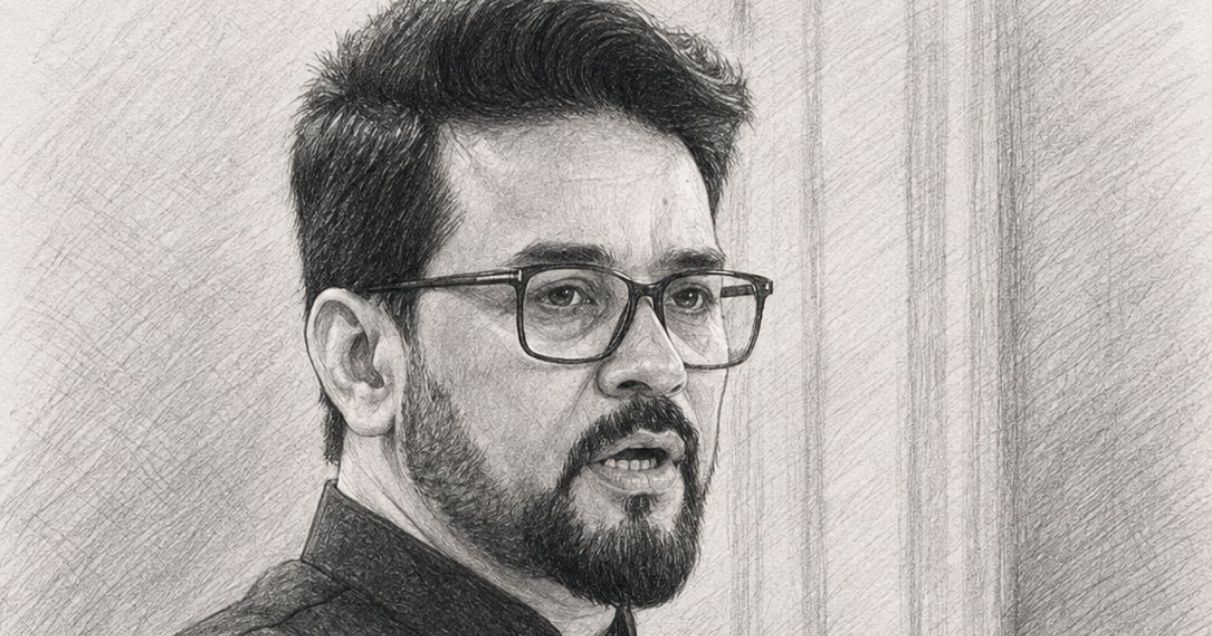
The Long Wait of Anurag Thakur
Five terms, two ministries, one cricket board, and, at 51, no job. A profile of the BJP's most conspicuously idle heavyweight.
28-08-2026

Five terms, two ministries, one cricket board, and, at 51, no job. A profile of the BJP's most conspicuously idle heavyweight.
28-08-2026On the afternoon of 17 August 2026, the Bharatiya Janata Party published the list of its new national office-bearers. It was the first full team assembled by Nitin Nabin, the 46-year-old who had taken over as party president in January and who had been briefed, by every account in the press, to bring the average age of the leadership down to somewhere around fifty and to widen the space for women and younger cadre before the 2027 assembly cycle.
The list did what such lists do. Thirteen national vice-presidents, including Vasundhara Raje and Ram Madhav and Manpreet Singh Badal. Eight general secretaries. Smriti Irani, out of office since 2024, restored to the top table as a national general secretary. Piyush Goyal named treasurer. B.L. Santhosh retained as the RSS's man in the machine. Anil Baluni kept on as media chief. A handful of names dropped without ceremony.
Anurag Singh Thakur's name was not on it.
For two days before the announcement, television and wire desks had run his name alongside Irani's as the obvious returnee, a five-term MP, a former Union Cabinet minister with two portfolios, a former national president of the party's youth wing, fifty-one years old, telegenic, fluent in Hindi and English, and a proven attack dog in the Lok Sabha. He was the textbook fit for exactly the team Nabin was said to be building. Then the list came out, and Himachal Pradesh, a state of four Lok Sabha seats that has supplied the BJP with a national president, a Union health minister and this man, was left without a single prominent position in the national organisation.
It was the second time in twenty-six months that Anurag Thakur had been read out of a list he was expected to be on. It is a strange place for him to be. He has lost no election. He has committed no public act of indiscipline. He is, by the arithmetic of Indian politics, young. And yet since June 2024 he has held no office that anyone outside Parliament's committee rooms could name.
He was born in Hamirpur on 24 October 1974, into the family of Prem Kumar Dhumal, schoolteacher, then MP, then twice chief minister of Himachal Pradesh, from 1998 to 2003 and again from 2007 to 2012. The family is Rajput, which in Himachal is not incidental: the state's politics has long been read through the balance between Rajputs and Brahmins, and between the Kangra–Hamirpur belt of the lower hills and the older Shimla-centred establishment.
Thakur went to Doaba College in Jalandhar and took a BA. He did not follow the standard route into politics through student unions and morcha work. He went into cricket administration instead, and he went in absurdly early: president of the Himachal Pradesh Cricket Association at twenty-five, a national junior selector at twenty-six. He played one first-class match for Himachal Pradesh, captaining the side, a line that his opponents have used against him for a quarter of a century and that he has never seemed embarrassed by.
Politics arrived as an inheritance, in the most literal sense. When Dhumal became chief minister in December 2007, he vacated the Hamirpur Lok Sabha seat. In the May 2008 bypoll, his elder son took it. Thakur has held it ever since 2009, 2014, 2019, 2024 five wins, the last by 1,82,357 votes.
Two things about that record are worth pausing on. The first is that Hamirpur is a fortress the BJP has won eleven times; the second is that Thakur's 2024 margin was less than half his 2019 margin of nearly four lakh. Both facts have been used, by different people, to explain everything that came afterwards.
The HPCA years are the part of the Thakur story that people who don't follow Himachal politics actually know. He turned a state association with no international status into the custodian of one of the most photographed cricket grounds on earth: the Dharamsala stadium, deodars and the Dhauladhar range rising directly behind the sightscreen. It hosted its first international in 2013. It made his name nationally in a way that no amount of constituency work would have.
From there he did what ambitious state association heads do. He climbed. Joint secretary of the BCCI, then secretary, then, on 22 May 2016, president of the richest sporting body in the world, at forty-one. He lasted seven months.
The BCCI presidency collided with the Supreme Court's implementation of the Lodha Committee reforms, and Thakur made the mistake of fighting it in a way the court took personally. On 2 January 2017, the bench ordered him and secretary Ajay Shirke to cease and desist from any association with the working of the BCCI, and initiated contempt and perjury proceedings against him over an affidavit concerning a letter he had sought from the then ICC chairman, Shashank Manohar. In July 2017 he appeared in person, offered an unconditional and unequivocal apology, and the contempt proceedings were dropped. The cease-and-desist direction stayed.
It stayed for nine years. That is the thing to hold on to. For nearly a decade, the most powerful sports administrator of his generation was formally barred from the sport that made him.
The political career absorbed the shock and kept moving. He had run the Bharatiya Janata Yuva Morcha nationally from 2011 to 2016, building a cadre network that would still be useful to him a decade later. He was commissioned into the Territorial Army in 2016, the first serving MP to be taken in as a regular officer, and holds the rank of captain, a detail he has used with some skill.
In May 2019 he became Minister of State for Finance and Corporate Affairs, deputy to Nirmala Sitharaman, and in the reshuffle of July 2021 he was promoted to Cabinet rank with two of the most visible portfolios in government: Information and Broadcasting, and Youth Affairs and Sports. At the time, the Shimla press read it as a straightforward statement of favour from Narendra Modi and Amit Shah, and as a reward for a minister who had been conspicuously willing to lead the charge against the Aam Aadmi Party in Delhi. The three years that followed were busy and contested.
At Sports, he inherited the wrestlers' agitation against the Wrestling Federation of India and its then chief, Brij Bhushan Sharan Singh, a confrontation involving Olympic and world medallists that ran through 2023 and produced some of the most damaging images the government faced that year. His ministry eventually suspended the newly elected WFI body. Supporters credit him with expanding Khelo India and the Target Olympic Podium Scheme and with putting India's ambition to host the 2036 Games on the diplomatic table. Critics argue that his handling of the wrestlers was slow, that the ministry protected the federation for too long, and that a minister who was himself a career sports administrator was structurally the wrong person to referee a fight about how federations are run.
At I&B he presided over the Cinematograph (Amendment) Act, over the tightening of the IT rules governing online content, over a stream of blocking orders against channels and apps on national-security grounds, and over the first drafts of a broadcasting services bill that was later shelved after heavy pushback from broadcasters and digital publishers. That record is either a serious modernisation of India's media law or a serious consolidation of the state's control over it, depending entirely on who is describing it.
There is a second Anurag Thakur, and it is the one that gets quoted.
In January 2020, campaigning for the Delhi assembly elections at a rally in Rithala, he led a crowd in the chant "Desh ke gaddaron ko" , and let them supply the response, which called for traitors to be shot. The Election Commission barred him from campaigning for 72 hours and struck him from the BJP's star campaigner list. The slogan has followed him since, into the Lok Sabha record, into opposition speeches, and into litigation.
In July 2024, a month after being dropped from the Cabinet, he stood up in the Lok Sabha and made a remark about Rahul Gandhi's caste that the Chair partly expunged. The Prime Minister publicly praised the speech within hours.
Those two episodes explain something important about his position. Thakur's value to the BJP has never been only administrative. He is one of the party's most reliable parliamentary bruisers, deployed when the government wants an opposition leader dismantled in Hindi on the evening bulletins. That role earns loyalty at the very top. It does not, by itself, earn a ministry, and it makes him a difficult figure to sell as a consensus chief-ministerial face in a small state where personal reputations travel by word of mouth.
He won Hamirpur for the fifth time. Then, on 9 June 2024, seventy-one MPs were sworn in as ministers and he was not among them. The explanations offered at the time, none of them official, were these.
The Nadda problem. J.P. Nadda, who was then still BJP national president and whose home base of Bilaspur falls inside the Hamirpur parliamentary seat, was inducted into the Cabinet as health minister. Himachal has four Lok Sabha seats. Two Cabinet ministers from four seats was never plausible. Once Nadda took the berth, Thakur's chances were effectively gone, and the two men had led rival camps inside the state unit for years, a rivalry that had broken into the open around the 2022 assembly ticket distribution and the wave of BJP rebels who ran against official candidates.
The bypoll arithmetic. Alongside the general election, Himachal held assembly bypolls caused by the defection of Congress MLAs. The BJP lost several of them, including in seats inside Thakur's own parliamentary constituency. Sujanpur — where Thakur personally posted his best margin, and where the BJP had fielded Rajinder Rana, the man who had defeated his father Dhumal in 2017 — went to Congress. Whatever the true causes, the result gave the high command a clean, deniable metric.
The margin. From nearly four lakh in 2019 to 1.82 lakh in 2024. Comfortable by any normal standard. A decline, in the only standard that matters at the top of the BJP.
His public response was the only one available to him: he was a party worker, he would do whatever work the party assigned. He has not deviated from that line in twenty-six months, in public or, so far as anyone has reported, in private. In a party that has watched Smriti Irani, Rajeev Chandrasekhar and others handle exclusion with varying grace, the discipline has been noticed.
What he actually got instead:
• Chairman, Standing Committee on Coal, Mines and Steel (September 2024). A real committee, a low-visibility one.
• Member, Public Accounts Committee — the House's most powerful audit panel, chaired by convention by an opposition MP.
• Member, Lok Sabha Business Advisory Committee (July 2024), which sets the House agenda. A genuine mark of trust from the Speaker and the treasury benches, and the first signal after his exclusion that he was not being frozen out entirely.
• Member of the Joint Parliamentary Committeeexamining the Constitution (130th Amendment) Bill and the associated J&K and Union Territories bills (November 2025) — one of the most politically loaded legislative exercises of the term, chaired by Aparajita Sarangi.
• President, Himachal Pradesh Olympic Association, re-elected unanimously in October 2025.
And what he tried for and did not get:
The Boxing Federation of India. In March 2025 he filed for the BFI presidency as a representative of the Himachal Pradesh Boxing Association, challenging the incumbent, SpiceJet's Ajay Singh. It went badly and it went publicly. The BFI struck his name from the electoral college on the grounds that he was not an elected member of the state unit. Vijender Singh, the Olympic bronze medallist and a fellow party member, said openly that politicians with no connection to a sport should not be running its federation. Thakur's camp went to the Himachal Pradesh High Court, won a stay, and got the March election postponed — after which World Boxing installed an interim committee, the constitution was rewritten, and when the election was finally held on 21 August 2025, Ajay Singh won a third term against a different challenger.
It was a small defeat with a large meaning. A decade earlier, Thakur had run Indian cricket. In 2025 he could not get himself onto a sixty-member electoral college in boxing.
Then the door reopened. In January 2026 he moved the Supreme Court to modify the 2017 order. On 5 February 2026, a bench of Chief Justice Surya Kant and Justice Joymalya Bagchi applied the doctrine of proportionality, held that the court had never intended a lifelong ban, noted the apology it had already accepted, and modified paragraph 25(ii) of the January 2017 order: Anurag Singh Thakur is free to participate in the affairs of the BCCI, subject to its rules and regulations.
Nine years of exclusion from Indian cricket, ended in a paragraph. Six months later, the party list came out without his name.
He is fifty-one and unbeaten. Five consecutive wins in a seat his family has held for a generation. Nothing in his record forecloses another twenty years.
The BCCI door is genuinely open. This is the single biggest change in his position since 2017, and it is underrated. The BCCI is the most valuable non-governmental office in India — a platform with global visibility, enormous patronage, and a long history of being held by serving politicians. He knows the board's machinery better than almost anyone in the country. He has a state association base. If the party wants to park him somewhere consequential without giving him political power, this is the obvious place, and the legal obstacle is gone.
The 2027 Himachal election. The state votes at the end of 2027 and has never re-elected an incumbent government. The BJP genuinely expects to win. Jai Ram Thakur, the former chief minister and current Leader of the Opposition, is the frontrunner, but he will be sixty-two, he lost in 2022, and Himachal has a habit of settling leadership questions after the votes are counted rather than before. Reporting from the state through 2026 has consistently placed Anurag Thakur in that race. He carries the Dhumal legacy in the Hamirpur–Kangra belt, which is where BJP majorities in Himachal are made.
The Nadda blockage is loosening. Nadda's presidency ended in January 2026. Thakur's chief internal obstacle is no longer running the party organisation.
He has behaved well. He has campaigned, spoken in the House, defended budgets, attacked the opposition, taken the committee work, and complained about none of it. The BJP has a demonstrated pattern of returning leaders who absorb humiliation without leaking, Irani's August 2026 restoration is the most recent proof, and it happened in the same list that excluded him.
And there is still a Cabinet. Reshuffles happen. A general election is due in 2029.
Twenty-six months is a long time, and the last two lists both said no. June 2024 could be explained by Nadda and by state arithmetic. August 2026 cannot. Nabin was building a young team and passed him over anyway. That is either a considered judgement about Thakur or a considered judgement about Himachal, and neither is good for him.
The state is not obviously his. He has never been an MLA. His base is a parliamentary seat and a family name, not a legislature party. Jai Ram Thakur has spent four years as Leader of the Opposition doing the daily, unglamorous work of running a state unit, and the BJP's recent instinct in the hills has been to promote the organisation man over the Delhi celebrity.
The federation defeat suggests thinner clout than the CV implies. In 2016 he could take the BCCI. In 2025, a boxing electoral college was beyond him. Some of that is the post-Lodha sports code and the courts; some of it is that a minister out of office is not the same asset to a state association that a minister in office is.
The record cuts both ways. The Supreme Court's 2017 findings about his conduct as BCCI president are permanent, and the modification order explicitly rests on an apology, not on exoneration. The 2020 slogan remains in circulation and in litigation. Neither is disqualifying in Indian politics. Both give an opponent, internal or external, something to work with.
The BJP does not owe anyone a second act. The party has a deep bench and a long list of leaders in their fifties who were once described as the future and are now described as senior. There is no mechanism that returns people to the top; there is only the decision of two or three men.
Four tripwires will tell you which way this is going, probably before the end of 2027:
1. Cricket. Any move by Thakur into the BCCI or back into HPCA office. This is now legally possible and would be the loudest available signal that he is being given a landing pad.
2. The Himachal campaign. Whether he is given a formal role, campaign committee, manifesto, election in-charge, or is left to campaign as a star speaker. The formal role is the tell.
3. A central reshuffle. Whether one happens at all, and whether Himachal is treated as having one seat at the table or two.
4. Silence. If Thakur stops being deployed as the government's front-line speaker in the Lok Sabha, the relationship at the very top has changed. As long as he is still the man handed the difficult debates, it hasn't.
The most useful way to read Anurag Thakur is not as a man who fell, but as a man who has spent his whole career being handed things early and then having them taken back.
The HPCA presidency at twenty-five. A national selector's job at twenty-six. A Lok Sabha seat at thirty-three, before he had contested anything. The BCCI at forty-one, gone in seven months by order of the Supreme Court. A Cabinet berth at forty-six, gone at forty-nine. A place on the party's national team, floated for two days in August 2026 and then not there.
He is fifty-one. That is not old for a politician who has already been a Union Cabinet minister and the president of the BCCI. It is, however, exactly the age at which the Indian political system stops calling you promising.
The comeback is entirely plausible. He has the seat, the name, the discipline, the age, the network, and, as of February 2026, his cricket career back. What he does not have, and has not had since June 2024, is any evidence that the people who make these decisions intend to make one in his favour.
He is waiting. In the BJP, that is a full-time job, and he appears to be good at it.

From the power and insolvency appeal courts to debt and military tribunals, chairs and member seats
Read More
An estimate of Yes Bank’s liability and capital impact after the Supreme Court’s ruling in Yes B
Read More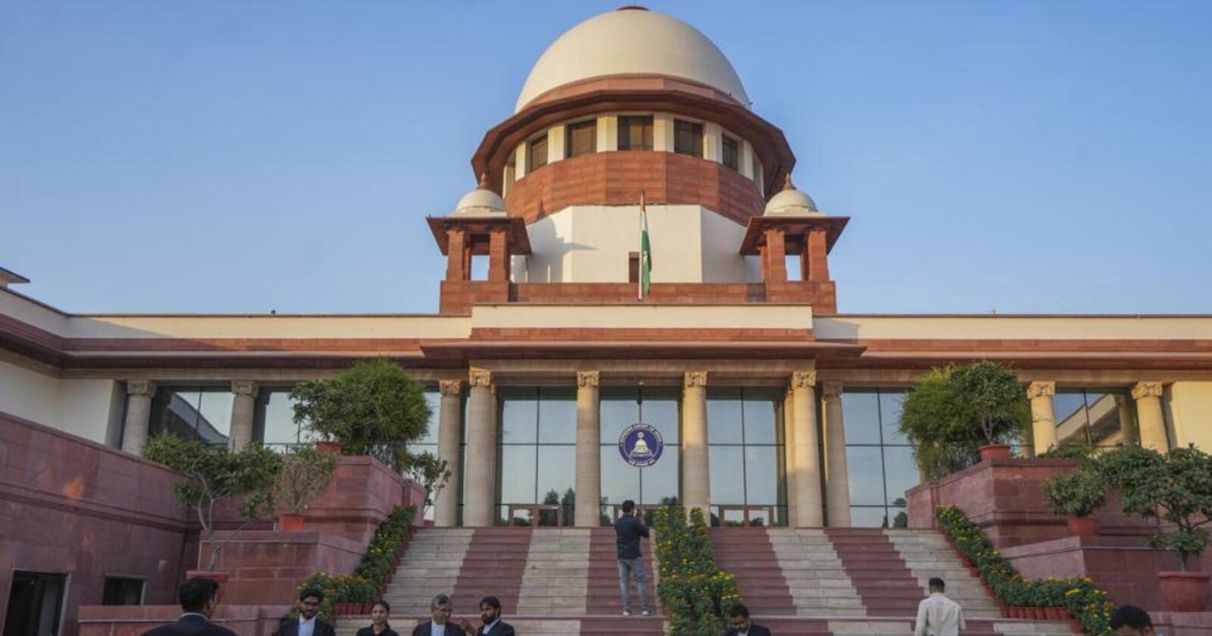
When the state wields a sledgehammer against citizens seeking accountability, the Supreme Court’s
Read More