When Death Changed Indian Politics
From Patel And Shastri To Sanjay, Indira, Rajiv, Pramod Mahajan And YSR, The Deaths That Changed Not Merely Who Governed India, But The Direction In Which Indian Politics Travelled
19-09-2026

From Patel And Shastri To Sanjay, Indira, Rajiv, Pramod Mahajan And YSR, The Deaths That Changed Not Merely Who Governed India, But The Direction In Which Indian Politics Travelled
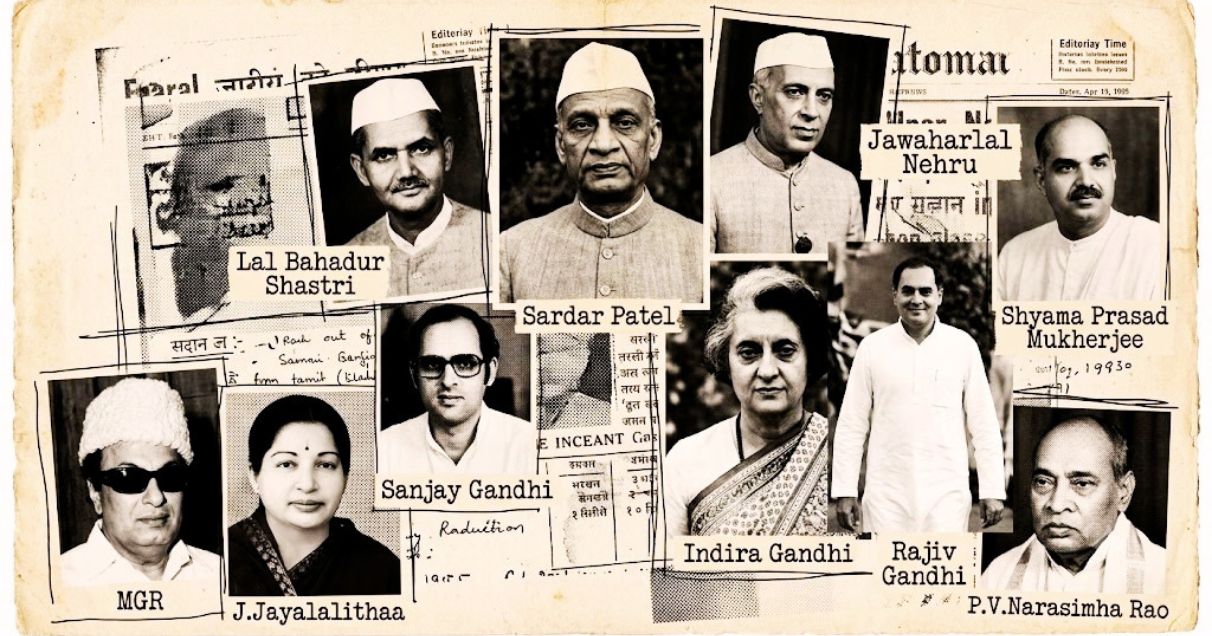
19-09-2026History is normally written through elections, wars, movements and decisions. But Indian political history has another, far more unpredictable author: death.
Again and again since Independence, the death of a politician has not merely created a vacancy. It has removed one side of a political equation, elevated somebody who might otherwise never have reached the top, destroyed carefully constructed succession plans and, occasionally, helped create an entirely new political dynasty or party.
There is an intriguing way to think about modern India: remove a handful of premature deaths from its history, and the political map of the country might be almost unrecognisable. Would Indira Gandhi have dominated the Congress as completely if Lal Bahadur Shastri had lived another decade?
Would Rajiv Gandhi ever have entered politics had Sanjay Gandhi landed his aircraft safely that June morning in 1980? Would P.V. Narasimha Rao, already preparing to leave frontline politics, have become Prime Minister had Rajiv Gandhi returned alive from Sriperumbudur?
Would Jayalalithaa have become the towering figure she did if M.G. Ramachandran had lived long enough to settle his succession? Where would Pramod Mahajan have stood when the BJP eventually made its generational transition if he had not been shot dead at only 56?
And would Y.S. Jagan Mohan Reddy have created his own political party had his father returned safely from a helicopter journey in September 2009? These are counterfactuals, not facts. But the events that provoke the questions are real.
On December 15, 1950, Vallabhbhai Patel died. Independent India was barely three years old.
Patel was Deputy Prime Minister and Home Minister, but those titles inadequately describe his political weight. Inside the Congress, he was perhaps the only leader whose stature could be spoken of in the same breath as Prime Minister Jawaharlal Nehru’s.
Their differences were real. Their approaches diverged on several questions, including the Congress organisation. In the bitter Congress presidential contest of 1950, Nehru opposed Purushottam Das Tandon while Patel supported him. Historical accounts of their relationship nevertheless also emphasise their cooperation within the government despite these disagreements.
Patel’s death therefore did something larger than remove India’s Home Minister. It removed Nehru’s great internal counterweight.
Nehru would still encounter disagreement and opposition, including within his own political family. But the Congress no longer contained another figure possessing Patel’s extraordinary combination of governmental authority, organisational influence and national stature.
India’s first great political partnership, sometimes cooperative, sometimes contentious, had ended. Nehru would remain Prime Minister for another thirteen and a half years.
Three years later came a very different death. Syama Prasad Mookerjee, founder of the Bharatiya Jana Sangh, had made Jammu and Kashmir’s special constitutional position one of his defining political campaigns.
In May 1953, he entered Jammu and Kashmir without the required permit as an act of protest. He was arrested. Before crossing into the state, Mookerjee sent his young associate Atal Bihari Vajpayee back to Delhi with a message: tell the country that he had entered Jammu and Kashmir, even if he had done so as a prisoner.
He never returned alive. Mookerjee fell ill in detention and died on June 23, 1953. His death generated controversies and allegations that persisted for decades, although claims of foul play have remained contested rather than established fact.
Politically, however, something indisputable happened. A constitutional dispute acquired a martyr. For generations of Jana Sangh and later BJP workers, Mookerjee’s death became inseparable from the demand for the fuller constitutional integration of Jammu and Kashmir. A politician died in 1953.
The political issue with which his final campaign was identified survived him for another 66 years, until the constitutional changes concerning Article 370 in 2019.
Then came May 27, 1964. Jawaharlal Nehru was dead. For a generation of Indians, Nehru and independent India had existed almost simultaneously. He had been Prime Minister from the moment of freedom. The question was suddenly obvious:
What happens to India without Nehru? The answer proved enormously important for Indian democracy. The system did not collapse. Home Minister Gulzarilal Nanda became interim Prime Minister while the Congress chose its new leader.
Behind the scenes, Congress president K. Kamaraj emerged as the great organiser of the succession. Morarji Desai had formidable credentials and ambition. But the party ultimately coalesced around the diminutive, understated Lal Bahadur Shastri. India had accomplished something whose importance is easier to appreciate in retrospect: power had passed peacefully after the death of the dominant founding Prime Minister.
And the successor was not Nehru’s daughter. Not yet.
Lal Bahadur Shastri’s premiership lasted barely nineteen months. Yet those months contained the 1965 war with Pakistan, the food crisis and one of the most durable political slogans in Indian history:
Jai Jawan, Jai Kisan. Then came Tashkent. On January 10, 1966, Shastri signed the Tashkent Declaration with Pakistani President Ayub Khan. Within hours, he was dead. The official cause was a heart attack. The circumstances surrounding his death have generated decades of speculation, but no alternative explanation has been established. Once again, Gulzarilal Nanda became caretaker Prime Minister.
And once again the Congress had to choose. This time Morarji Desai wanted the job. But another candidate emerged: Indira Gandhi.
Less than a fortnight after Shastri’s death, Nehru’s daughter was Prime Minister. That single succession would eventually transform the Congress itself.
The old party organisation would split. Indira would centralise political authority around herself, nationalise banks, abolish privy purses, win the 1971 election, oversee the Bangladesh war, impose the Emergency, lose power, and then return to it.
Shastri’s death did not make those events inevitable. But it opened the door through which Indira Gandhi walked.
Perhaps no death demonstrates the strange role of contingency in Indian politics better than that of Sanjay Gandhi. On the morning of June 23, 1980, Sanjay took off from Delhi’s Safdarjung Airport in a Pitts aerobatic aircraft. He was 33. Minutes later, the aircraft crashed. Sanjay was dead.
The political consequence was extraordinary because the Gandhi family already had another son — one who had deliberately stayed away from politics. Rajiv Gandhi was an Indian Airlines pilot. His world was aircraft, family and a relatively private existence. Sanjay’s death changed the equation.
Pressure grew on Rajiv to help his mother politically. He eventually entered politics and won the Amethi parliamentary seat that had fallen vacant because of Sanjay’s death. It is one of the great domino effects of modern Indian history:
Sanjay dies → Rajiv enters politics → Indira is assassinated → Rajiv becomes Prime Minister.
Had the Pitts aircraft landed safely that morning, the political careers of both brothers, and therefore the history of the Congress, could have been radically different.
On the morning of October 31, 1984, Prime Minister Indira Gandhi walked through the garden of her residence towards an interview. Two of her Sikh bodyguards assassinated her. India changed before the day was over. Rajiv Gandhi, only 40, was sworn in as Prime Minister. The assassination was followed by horrific anti-Sikh violence, particularly in Delhi.
Then came the general election. The political response was unprecedented. Congress won 404 of the 514 seats decided in the December 1984 election; with subsequent polling in Assam and Punjab, its final tally in the Eighth Lok Sabha reached 414. That remains the largest Lok Sabha seat tally won by a single party.
Rajiv had gone in four years from being a commercial pilot with little apparent political ambition to possessing the largest parliamentary majority in Indian history. But the moment contained another historical irony.
Congress has never again won a Lok Sabha majority on its own after 1984. Its greatest electoral triumph also marked the end of the era in which Congress majorities could be taken for granted.
If Delhi demonstrated how death could alter national politics, Tamil Nadu showed how it could remake an entire state party. M.G. Ramachandran was more than Chief Minister.
To millions of supporters, MGR was cinema, welfare politics, charisma and political identity fused into one man. He had won the Tamil Nadu elections of 1977, 1980 and 1984 and remained Chief Minister until his death in December 1987.
But he left no uncontested successor. The AIADMK fractured. One faction rallied behind his widow, Janaki Ramachandran. Another rallied around his former film co-star and political protégé: J. Jayalalithaa. The succession battle was bruising.
Janaki briefly became Chief Minister. The divided AIADMK suffered badly in the 1989 election. Janaki subsequently withdrew from politics and the factions reunited under Jayalalithaa. By 1991, Jayalalithaa was Chief Minister. MGR’s death had therefore produced not simply a succession crisis but the conditions in which another of India’s most consequential regional leaders emerged.
Seven years after his mother’s assassination, Rajiv Gandhi was campaigning to return to power. On May 21, 1991, he travelled to Sriperumbudur in Tamil Nadu. A woman approached him at an election rally. She bent towards him. The suicide bomb exploded.
Rajiv Gandhi was 46. India’s election was already underway. The remaining phases were postponed. And suddenly the Congress had no obvious candidate for Prime Minister. One of the strangest political reversals in Indian history followed.
P.V. Narasimha Rao had effectively been preparing to withdraw from frontline politics. After Rajiv’s assassination, he was drawn back into the centre of events. Sonia Gandhi declined to take charge of the party. Rao became Congress president and, after the election, Prime Minister. Then came another historical turn.
India was facing a severe balance-of-payments crisis. Rao appointed Manmohan Singh Finance Minister. The government dismantled significant parts of the Licence Raj and launched the economic liberalisation programme associated with 1991.
The same government would confront the demolition of the Babri Masjid and the communal and political upheavals that followed. Economic reform was already being discussed before Rajiv’s death, and it would be simplistic to attribute liberalisation to the assassination.
But the identity of the Prime Minister who implemented those reforms was unquestionably changed by what happened at Sriperumbudur. A man preparing for political retirement instead governed India for five years.
N.T. Rama Rao’s final months were almost Shakespearean. The film superstar who had created the Telugu Desam Party and overturned Congress dominance in Andhra Pradesh found himself deposed in 1995 by his own son-in-law, N. Chandrababu Naidu, after a revolt among TDP legislators.
At the heart of the conflict was intense disagreement over the political influence of NTR’s second wife, Lakshmi Parvathi. NTR refused to accept quietly what had happened. Then, in January 1996, he died.
Until then, national opposition politicians faced an awkward question: should they recognise NTR, the charismatic founder of the TDP, or Naidu, who controlled most of its legislators and the state government?
Death effectively resolved what rebellion had begun. Lakshmi Parvathi’s breakaway political vehicle failed to displace the mainstream TDP, and Chandrababu Naidu consolidated control. The TDP that subsequently became an influential player in India’s coalition era was Naidu’s TDP.
Sometimes death changes history not by immediately creating a Prime Minister but by removing someone who might have competed for power later. The Congress experienced two such blows within sixteen months. Rajesh Pilot died in a road accident in June 2000.
He was only 55. Pilot was one of the relatively few Congress politicians prepared to contest internal authority. In 1997 he had challenged Sitaram Kesri for the Congress presidency, and by 2000 he remained part of the debate about the party’s leadership.
Then, in September 2001, Madhavrao Scindia died when the aircraft carrying him to a political rally crashed near Mainpuri. He was 56.
Scindia was Sonia Gandhi’s deputy in the Lok Sabha and was widely regarded as one of the Congress’s substantial second-generation leaders. History cannot tell us whether either man would have become Congress president or Prime Minister.
But it can tell us what disappeared with them: two relatively young, electorally grounded national politicians at precisely the time the Congress was struggling to replenish its leadership. Sometimes the importance of a death lies in the political future that never gets the opportunity to occur.
Then came one of the most extraordinary political deaths of them all. On the morning of April 22, 2006, Pramod Mahajan was at his home in Worli, Mumbai. His younger brother Pravin arrived. Within minutes, Pramod Mahajan had been shot. He was rushed to Hinduja Hospital and fought for his life for twelve days. On May 3, he died. He was just 56.
Pravin Mahajan was subsequently convicted of his murder. But the significance of the killing went beyond the horrific circumstances of a family tragedy. Pramod Mahajan was one of the BJP’s important bridge figures. Atal Bihari Vajpayee and L.K. Advani represented the party’s towering older generation. Beneath them was an emerging group that included politicians such as Sushma Swaraj and Arun Jaitley.
Mahajan occupied a distinctive position within that transition. He was a strategist, fundraiser, campaign manager, coalition negotiator, television performer and political networker rolled into one.
He understood something that would become increasingly important in twenty-first-century politics: politics was no longer merely about the public meeting and the party office. It was also about television, advertising, technology, corporate India, messaging and relentless communication.
Mahajan belonged to the BJP but seemed equally comfortable in television studios, corporate boardrooms and conversations with politicians far outside the BJP family. Politics, for him, was also the art of knowing everybody. And then, suddenly, he was gone. His death came at an especially consequential moment.
The Vajpayee era was ending. Advani remained the BJP’s central leader, but the question of generational succession was becoming increasingly important. Mahajan’s death removed one of the politicians who might have been part of that transition.
It would be wrong to state as fact that he would have become BJP president or Prime Minister. Those possibilities are unknowable.
What can be documented is that his organisational absence was felt. Three years after his death, The Indian Express reported that the BJP was still struggling to replace Mahajan’s particular role in Maharashtra, including his ability to manage the party’s relationship with the Shiv Sena.
His absence also affected the distribution of strategic responsibilities within the BJP. Arun Jaitley became one of the party’s principal election managers and troubleshooters during the years that followed.
There is a particularly haunting anecdote from the tragedy. Mahajan reportedly had a bumper sticker at his Delhi residence: “Friends Welcome Anytime. Relatives By Appointment Only.”
The brother who ultimately shot him arrived at his Mumbai home that April morning. For twelve days India watched. Then the BJP lost, at 56, a politician who had spent much of his career preparing the party for the future ,without ever getting the chance to discover what his own place in that future would have been.
On September 2, 2009, Andhra Pradesh Chief Minister Y.S. Rajasekhara Reddy boarded a helicopter. He had only recently led the Congress to another Assembly victory. The helicopter disappeared over the Nallamala forest. The wreckage was found the following day. YSR was dead.
Almost immediately, the question of succession erupted. His supporters demanded that his son, Y.S. Jagan Mohan Reddy, be made Chief Minister. He wasn’t.
K. Rosaiah took office. The consequences unfolded over the following years. Jagan’s relationship with the Congress deteriorated. He eventually left. And he created the YSR Congress Party.
The new party would become one of the principal forces in Andhra Pradesh politics. Once again the sequence is remarkable:
YSR dies → succession is disputed → Jagan breaks with Congress → YSR Congress emerges → Andhra’s party system is transformed.
A helicopter crash had ultimately helped produce a new regional political order.
There is no single lesson connecting these deaths.
Patel died naturally.
Shastri died suddenly abroad.
Sanjay Gandhi and Madhavrao Scindia died in aircraft crashes.
Rajesh Pilot died on the road.
Indira and Rajiv Gandhi were assassinated.
MGR died after prolonged illness.
Pramod Mahajan was murdered by his own brother.
YSR died in a helicopter crash.
But look at their political consequences and a remarkable pattern emerges.
Patel’s death removed Nehru’s most formidable internal counterweight.
Mookerjee’s death helped turn the Kashmir question into a defining cause for the political tradition he founded.
Nehru’s death tested, and demonstrated, India’s capacity for peaceful democratic succession.
Shastri’s death opened the premiership to Indira Gandhi.
Sanjay’s death pulled Rajiv Gandhi into politics.
Indira’s assassination made Rajiv Prime Minister and was followed by an unprecedented Congress electoral mandate.
MGR’s death produced the succession battle from which Jayalalithaa eventually emerged dominant.
Rajiv’s assassination unexpectedly brought P.V. Narasimha Rao to power at the moment India undertook historic economic reforms.
NTR’s death ended one phase of the struggle for the Telugu Desam and helped Chandrababu Naidu consolidate the party.
The deaths of Rajesh Pilot and Madhavrao Scindia depleted a generation of potential Congress leadership.
Pramod Mahajan’s murder removed one of the BJP’s prominent next-generation strategists while the Vajpayee-Advani generation was approaching transition.
YSR’s death triggered a succession conflict from which the YSR Congress eventually emerged.
The fascinating thing about political history is that none of this was pre-written.
On the morning Sanjay Gandhi climbed into his aircraft, Rajiv Gandhi was not preparing to become Prime Minister. When Shastri travelled to Tashkent, Indira Gandhi did not know that within days she would be fighting Morarji Desai for the leadership of India.
When Rajiv Gandhi arrived at Sriperumbudur, Narasimha Rao did not know that a month later he would be Prime Minister. When Pramod Mahajan opened the door to his brother in Mumbai, he was one of the most visible politicians of the BJP’s next generation.
And when YSR’s helicopter took off, there was no YSR Congress Party. We often imagine history as a procession of great personalities carrying out grand plans.
It is also shaped by accidents, illnesses, assassinations, succession battles and moments when one person unexpectedly disappears from the board. Perhaps that is the most unsettling lesson of India’s political history.
Elections decide who wins power. But occasionally, death decides who gets the chance to compete for it at all.

From the power and insolvency appeal courts to debt and military tribunals, chairs and member seats
Read More
An estimate of Yes Bank’s liability and capital impact after the Supreme Court’s ruling in Yes B
Read More
When the state wields a sledgehammer against citizens seeking accountability, the Supreme Court’s
Read More