1. The Uncomfortable Arithmetic
The Insolvency and Bankruptcy Code turned ten this year. The anniversary has produced the expected volume of self-congratulation: a behavioural revolution in the credit market, thousands of debtors settling before admission, a creditor-in-control philosophy that displaced a debtor-in-possession culture, and a Code that has, on the government's own telling, put more than four lakh crore rupees back into creditors' hands. All of this is true. None of it is the point.
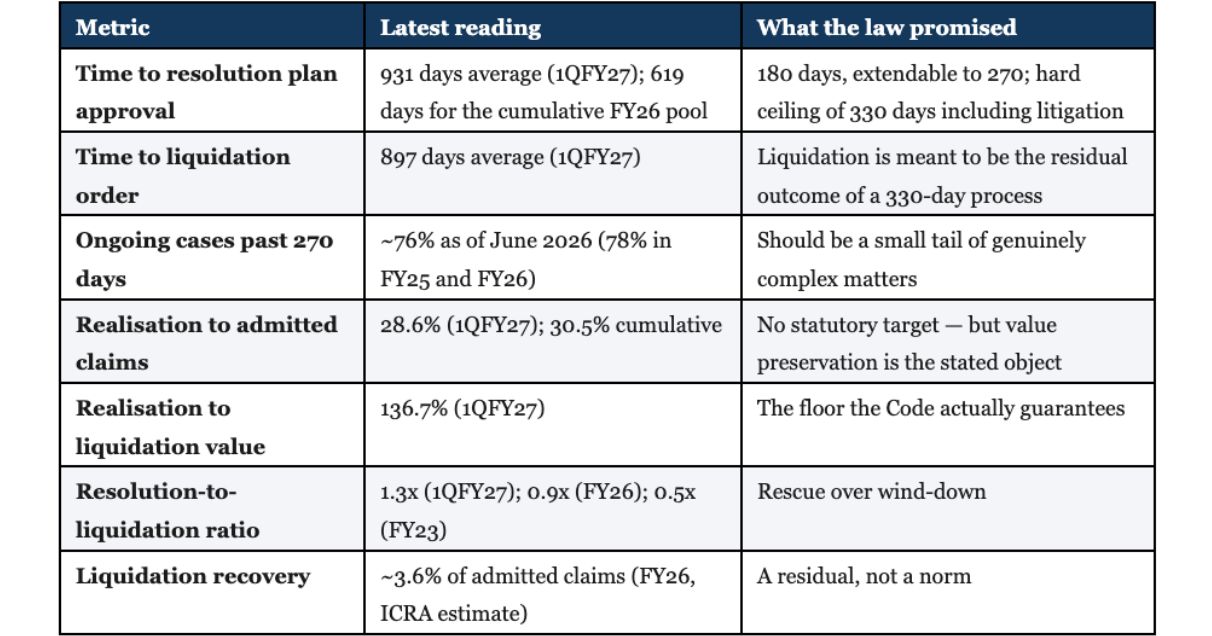
The point is what happens to a company once it actually enters the process. And on that question, the most recent data is not merely disappointing, it is flat. India Ratings' latest review of insolvency outcomes finds that creditors realised 28.6% of admitted claims in the 69 CIRPs that yielded resolution plans in 1QFY27, against a cumulative figure of 30.5% across 1,484 approved plans since 2016. The cases took an average of 931 days. Around 76% of all ongoing CIRPs had already blown through the 270-day threshold as of June 2026. Cases that ended in liquidation during the quarter had been alive for an average of 897 days before someone finally switched off the lights.
Read those numbers together and the conclusion is unavoidable: after ten years, four sets of amendments, hundreds of regulatory circulars, a Supreme Court jurisprudence of genuine sophistication, and a brand-new Amendment Act in April 2026, the operating performance of India's insolvency system has not structurally improved. Recovery is range-bound. Timelines are getting worse, not better. The expectations priced into stressed-asset valuations, security receipt ratings and bank provisioning models are running well ahead of anything the data supports.
This is a wake-up call, not an obituary. The IBC is the best insolvency architecture India has ever had, and the case for fixing it is precisely that it is worth fixing. But fixing it requires first admitting, without hedging, that the current design has failed on its single most important promise: speed.
Sources: IBBI Quarterly Newsletter, India Ratings & Research analysis, ICRA performance update, IBC 2016 as amended.
2. Five Failures the Headline Numbers Conceal
Failure One: The statutory clock is a work of fiction
Section 12 of the Code prescribes 180 days, extendable by 90, with a 330-day outer limit that expressly includes time spent in litigation. The observed average is 931 days, and that is the number after excluding periods the adjudicating authority has formally excluded. The real elapsed time from admission to approval, on the promoter's calendar and the asset's calendar, is longer still.
When the Supreme Court read the word "mandatorily" in Section 12(3) as directory rather than imperative, it did so for defensible reasons: a creditor should not lose a viable resolution because a tribunal was slow. But the practical effect has been to convert a deadline into an aspiration. A timeline with no consequence attached to its breach is not a timeline. It is a preference.
The distribution of delay matters more than the average. Roughly three-quarters of live cases are past the 270-day mark. This is not a long tail of Essar-scale complexity. It is the central tendency of the system. A process in which the exception has become the rule has stopped being a process and become a queue.
Failure Two: The recovery number is not a haircut, it is decay
The standard defence of the IBC's recovery rate goes like this: a 70% haircut looks bad only if you assume the assets were worth 100 to begin with. Creditors realised 136.7% of liquidation value and 112.0% of fair value in 1QFY27. Against the realistic counterfactual , piecemeal liquidation of a dead company, resolution is clearly value-accretive. The Finance Minister has made this argument in Parliament, and she is right.
But the defence proves less than it appears to. Liquidation value and fair value are both measured at or near the commencement of CIRP, by which point the asset has usually already been destroyed. Beating a number that was struck after the value had eroded is not the same as preserving value. It is grading on a curve the debtor set.
The more honest test is time-adjusted. A rupee recovered after 931 days is not a rupee. At a 12% cost of funds, 28.6% of admitted claims received two-and-a-half years after admission has a present value of roughly 21%. Add the post-approval implementation lag that India Ratings flags , the period between a plan being approved and cash actually moving, and the economic recovery falls closer to 19%. The headline number overstates what creditors actually get by something like a third.
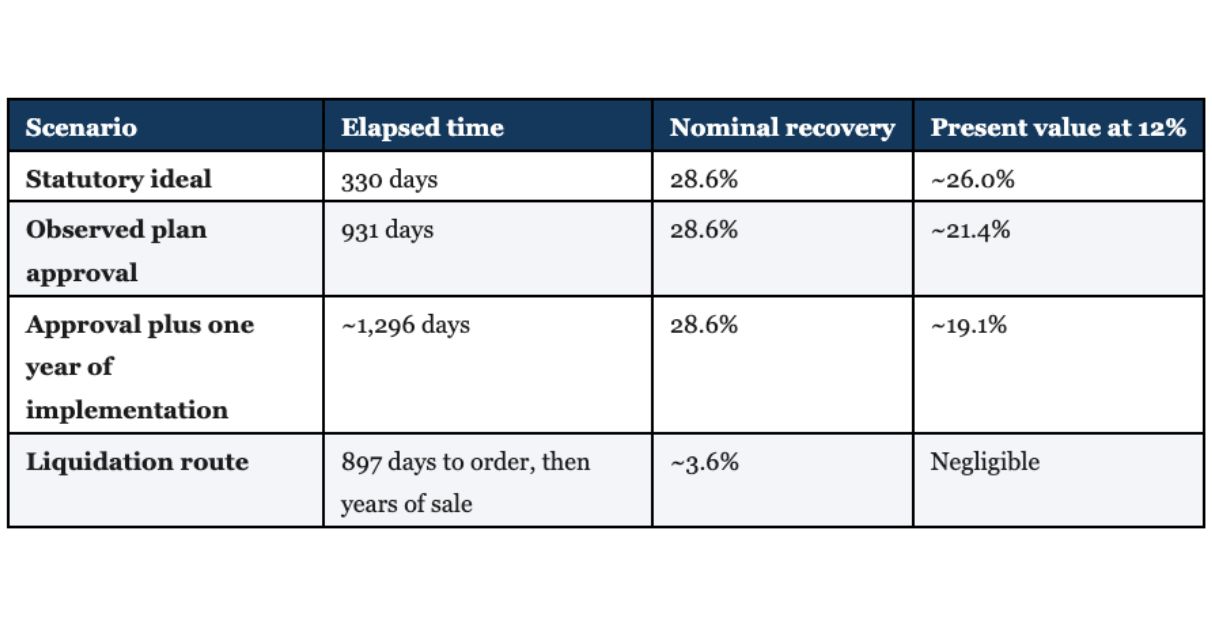
Illustrative. Assumes recovery received as a single sum at the stated horizon, discounted at a 12% annual cost of funds. Nominal recovery held constant to isolate the timing effect.
For a stressed-asset investor, timing is not a secondary variable. In a security-receipt structure with an eight-year life and a management-fee drag, a two-year delay can consume the entire expected excess return, even if the ultimate rupee recovery is exactly as underwritten.
Failure Three: The averages are carried by a handful of giants
The aggregate recovery statistic is one of the most misleading numbers in Indian finance, because it is an amount-weighted average dominated by a small number of very large, very attractive assets. ICRA's analysis is blunt on this: accounts with admitted claims above Rs 1,000 crore account for roughly 11% of resolved cases but around 89% of total recovery. In the fourth quarter of FY26, an overall recovery rate of about 23% was driven by realisation of roughly 91% of admitted claims in those large accounts.
Strip out the mega-cases and the picture for the median creditor in the median case is considerably worse than 30%. The steel and cement assets that produced the IBC's marquee outcomes were bought by strategic acquirers in a commodity upcycle. They were never representative. Reporting a single blended figure lets the system take credit for a cyclical windfall in a dozen cases while a thousand smaller companies grind through three years of tribunal listings to recover single digits.
Failure Four: Approval is a milestone, not a payment
There is a category of delay that almost no official statistic captures: the gap between the date a resolution plan is approved and the date cash reaches creditors. India Ratings, which observes this directly across security-receipt transactions, is explicit that approval frequently represents an intermediate step rather than the end of the recovery process. Implementation conditions, pending applications, regulatory approvals, appeals by aggrieved stakeholders and disputes over the distribution waterfall can all delay actual realisation by quarters or years after the tribunal has signed the order.
This matters enormously for anyone marking a position. A rating, a provision, or a valuation built off "plan approved" as the recovery event will systematically overstate performance. The industry has been measuring the wrong milestone for a decade. Until IBBI publishes approval-to-realisation data as a standard series, nobody — including the regulator — knows the true duration of an Indian insolvency.
Failure Five: The assets arrive dead
Around 42% of CIRPs that yielded resolution plans involved companies that were previously before the Board for Industrial and Financial Reconstruction or were already defunct when the process began. Creditors realised 17.52% of admitted claims in those cases, against 33.30% where the debtor was operational at commencement. On the liquidation side the skew is worse: on the government's own numbers, roughly 78% of CIRPs that ended in liquidation involved BIFR or defunct entities whose economic value had almost entirely eroded before admission.
Two conclusions follow. First, a meaningful share of the IBC's poor aggregate recovery is not the IBC's fault at all, it is the accumulated debris of the pre-2016 regime and of banks' own reluctance to recognise stress early. Second, and far less comfortably, the same pattern is being reproduced in real time. Lenders still treat insolvency as the terminal option after years of restructuring, refinancing and forbearance. Every month of delay before filing converts a rescuable business into a scrap-value auction. The Code cannot preserve value in an asset that had none left when it walked through the door.
A note on who actually gets paid
The distributional picture reinforces the point. In CIRPs yielding resolution plans in 1QFY27, financial creditors realised about 31% of their claims, operational creditors about 25%, and corporate debtors' other stakeholders about 18%. In liquidation, those figures collapse to roughly 5.4%, 8.3% and 7.0% respectively. The gap between resolution and liquidation is, for a financial creditor, a factor of nearly six. That is the strongest available argument for accelerating resolution — and the strongest available indictment of a system in which 76% of live cases are already over time.
3. Why It Is Happening
Delay is not a mysterious emergent property. It has identifiable causes, and most of them are institutional rather than legal.
The tribunal is structurally under-built
The National Company Law Tribunal has a sanctioned strength of 62 members, one President, 31 judicial and 31 technical, and that strength has not changed since the Tribunal was constituted, even though the IBC subsequently handed it an entirely new and enormous jurisdiction. As of mid-2026 the Tribunal was functioning with roughly 51 members against that sanction. Insolvency matters now account for more than half its total caseload, on top of its undiminished responsibilities under the Companies Act.
The judiciary has stopped being polite about this. In April 2026, hearing AVJ Heightss Apartment Owners Association v. IIFL Finance, the Supreme Court recorded that 383 applications seeking approval of resolution plans were pending before the NCLT, with delays ranging from 48 days to 738 days, described the situation as grim, and took suo motu cognisance. The resulting proceeding, In Re: Appointment of Judicial and Technical Members and Inadequate Infrastructure in NCLT, is now before the Court. In August 2026, the Parliamentary Standing Committee on Personnel, Public Grievances, Law and Justice recommended that the Ministry of Corporate Affairs examine dedicated IBC benches or verticals within the Tribunal.
When the Supreme Court and a Parliamentary committee independently arrive at the conclusion that the adjudicating forum is the binding constraint, the diagnosis can be treated as settled. Practitioners add a related point: the four-year tenure prescribed for members is too short to attract senior practising counsel, who would have to abandon a practice and then rebuild it. The Tribunal is being asked to run the most consequential commercial jurisdiction in the country on a staffing model designed for a smaller one.
Delay has become a strategy, because it is free
For a promoter facing displacement under Section 29A, every additional month is an option with positive value and almost no cost. Interlocutory applications, jurisdictional objections, claim disputes, challenges to the resolution professional, appeals to the NCLAT and then to the Supreme Court, each is individually defensible and collectively fatal. The Bhushan Power and Steel saga, which ran for the better part of a decade before the Supreme Court set aside the approved plan, is the extreme case, but the logic operates at every scale.
Until very recently there was no financial consequence for filing a hopeless application. The 2026 Amendment Act introduces a penalty for frivolous or vexatious proceedings ranging from one lakh to two crore rupees. That is a start. Whether it bites depends entirely on whether tribunals are willing to impose it.
The real fight is about distribution, not viability
A surprising proportion of insolvency litigation is not about whether a plan is viable. It is about who stands where in the waterfall: operational creditors arguing equitable treatment, dissenting financial creditors arguing their liquidation-value floor, statutory authorities asserting priority for government dues, homebuyers as a class, workmen's dues, and inter-creditor disputes between secured lenders with different security packages. These are genuine questions of law and fairness. They are also questions that need not hold the operating business hostage while they are resolved.
The resolution professional holds a weak hand
The RP is expected to take custody of a company whose records are frequently incomplete or missing, whose management is often uncooperative, and whose avoidance transactions must be identified and litigated within compressed timelines, while being paid on a scale that bears no relation to the complexity involved. Avoidance applications running to tens of thousands of crores have been left pending for years. The function has been professionalised on paper; it has not been resourced.
The market plumbing is missing
Three absences matter. There is no functioning market for interim or debtor-in-possession finance, so companies in CIRP starve operationally while the process runs, which is precisely why a 931-day timeline destroys going-concern value. There is a thin domestic buyer base for mid-sized distressed assets, so the resolution applicant pool for a Rs 300 crore company is often one or two parties, or none. And the pre-packaged insolvency resolution process, introduced in 2021 for MSMEs, has been used a negligible number of times, leaving the only available route the most expensive one.
4. What the 2026 Amendment Act Fixes, and What It Leaves Untouched
The Insolvency and Bankruptcy Code (Amendment) Act, 2026 received assent on 6 April 2026 and most of its provisions came into force on 26 May 2026. It is a serious piece of legislation, over sixty sections, drafted after a Select Committee process under Baijayant Panda that ran from August 2025 to December 2025. It deserves credit before it deserves criticism.
What it gets right
• Two-stage plan approval. The Adjudicating Authority may now approve implementation of a resolution plan first, and approve the manner of distribution separately within 30 days. This is the single most important timing reform in the Act, because it decouples the business from the fight over the waterfall. If tribunals use it aggressively, it alone could remove months from the back end of every contested case.
• Mandatory admission. Once default is established and procedural requirements are met, the Tribunal shall admit and may not reject on other grounds, with a 14-day decision window and written reasons required for any delay. A record of default filed by a financial institution is sufficient evidence of default. This attacks a delay stage that had quietly grown to consume a year or more.
• The clean slate, codified. Section 31 now expressly provides that claims not dealt with in an approved plan stand extinguished, and that licences, grants and concessions cannot be terminated during their remaining term if conditions are met. Resolution applicants have been pricing in the risk of post-acquisition surprise claims for years; this should show up directly in bid values.
• Security interest clarified. The definition now covers only interests created by agreement, expressly excluding those arising by operation of statute. This reverses the practical effect of the Rainbow Papers line of reasoning and restores the Section 53 waterfall's integrity against government dues.
• A creditor-initiated, out-of-court route. The new CIIRP under Chapter IV-A allows notified classes of financial creditors holding 51% in value to commence a debtor-in-possession process outside court, on 30 days' notice, with a 150-day timeline extendable by 45, convertible into a full CIRP if the debtor does not cooperate.
• Hard timelines elsewhere. Liquidation must now complete within 180 days plus 90; voluntary liquidation within a year; NCLAT appeals within three months; plan approval orders within 30 days; withdrawal applications within 30 days.
• Avoidance look-back shifted. The reference point moves from the insolvency commencement date to the initiation date, so that a promoter can no longer benefit from the very delay he engineered. Creditors may now approach the Tribunal directly if the RP fails to act.
What it does not fix
The Act is a reform of rules. The binding constraint is capacity, and rules do not create judges.
• Every new deadline sits on the same Tribunal. Admit in 14 days, approve in 30, dispose appeals in 3 months, all of it lands on a bench strength of roughly 51 that already carries more than half its docket in insolvency. Requiring written reasons for delay is a transparency measure, not a capacity measure. A tribunal that misses a deadline will now miss it in writing.
• Timelines still have no teeth. Nothing in the Act attaches a consequence to a breached deadline. The jurisprudence that made Section 12(3) directory rather than mandatory remains untouched.
• Group and cross-border insolvency are promises, not frameworks. Both are delegated entirely to rules the Central Government may frame. The Insolvency Law Committee recommended adopting the UNCITRAL Model Law, now in force in over sixty jurisdictions, in 2018. Eight years later, India has an enabling clause. Commentators have already flagged that delegating this much substantive policy without statutory guiding principles invites constitutional challenge.
• CIIRP is conditional on notifications that have not issued. It is available only to notified classes of financial creditors, against notified categories of debtors. Until those notifications arrive, the flagship reform is dormant. There is also a live design flaw: because CIIRP can be triggered only by notified financial creditors on default of their own debt, a company under stress has an incentive to keep operational creditors current and default on the banks last.
• The withdrawal window has been narrowed. Section 12A withdrawal is now confined to the period after CoC constitution and before the first invitation for plans, with 90% CoC consent. Settlements are the cheapest form of resolution and account for a large share of all IBC outcomes. Restricting the exit ramp may push into the Tribunal cases that would otherwise have left it.
The 2026 Act is a well-drafted answer to the question "what does the law say?" The problem India has is the question "who is available to hear it, and when?"
5. Remedies: A Twelve-Point Agenda
What follows is ordered by expected impact per rupee of effort, not by ease of implementation. Items in the first group would move the needle within eighteen months; items in the last group are structural and will take longer, but nothing else is durable without them.
A. Relieve the bottleneck (0–18 months)
1. Create dedicated IBC benches and raise sanctioned strength
The Parliamentary Standing Committee has already recommended dedicated insolvency benches or verticals within the NCLT. This should be implemented, and it should be accompanied by an increase in sanctioned strength from 62, a number set before the IBC existed, to a level derived from actual caseload, with a published methodology. Judicial and technical members hearing insolvency should hear only insolvency. Specialisation compounds: a bench that hears its twentieth avoidance application decides it faster than a bench that hears its first.
2. Fill vacancies and extend tenure
Roughly a sixth of sanctioned posts are vacant while the Supreme Court supervises the appointment process. Vacancies should be filled on a rolling basis with selection commenced six months before a known retirement, not after it. The four-year tenure should be extended to five years or more for judicial members drawn from practice; no competent practitioner will dismantle a practice for a four-year assignment, which is why the pool skews narrow.
3. Fix the registry, not just the bench
A significant share of delay occurs before a matter is ever heard: scrutiny, defect curing, listing and adjournment. End-to-end e-filing with published scrutiny service levels, automated listing with fixed dates, and a default rule that adjournments are granted only once without costs would shorten the calendar without requiring a single new appointment. Infrastructure matters too, the Principal Bench operating across scattered buildings in a high-security zone is not a trivial inconvenience; it is a throughput tax.
4. Publish bench-level performance data
IBBI and the NCLT should jointly publish a quarterly dashboard showing, per bench: median days from filing to admission, admission to plan approval, plan approval to first cash distribution, and pending applications by age band. Measurement is the cheapest discipline available. It is also the fastest way to distinguish benches that need more members from benches that need different practices.
B. Make time expensive for the party causing the delay
5. Attach consequences to deadlines
A deadline without a consequence is advisory. Options, in ascending order of aggression: mandatory written explanation to the NCLAT for any matter crossing 330 days; automatic transfer to a designated fast-track bench; deemed admission if an application under Section 7 is not disposed of within the statutory 14 days and no reasons are recorded; and a presumption of costs against any party whose conduct caused the overrun.
6. Price interlocutory litigation
The 2026 Act's penalty for frivolous proceedings should be supplemented by a deposit requirement for appeals against plan approval brought by promoters or connected parties, refundable on success, and by a default rule of indemnity costs where an appeal is dismissed without substantial question. The objective is not to deny access to remedy. It is to make the option value of delay something the delaying party pays for.
7. Use the two-stage approval order as the default, not the exception
The new proviso to Section 31(1) is the most underrated provision in the Act. CoCs and resolution professionals should be applying for implementation-first orders as a matter of routine in any case with a live distribution dispute, and IBBI should say so in CIRP Regulations rather than leaving it to develop case by case. Every month the operating business waits for a waterfall argument to conclude is a month of enterprise value being burned to settle a question about how to divide the ashes.
C. Get assets into the process earlier and healthier
8. Make referral timing a supervised metric
The single largest determinant of recovery is the condition of the asset on admission, 33.30% for operational entities against 17.52% for defunct ones. That condition is decided long before the RP is appointed. The RBI should require lenders to disclose, at the portfolio level, the distribution of elapsed time between first default and insolvency filing, and should treat persistent referral lag as a supervisory concern. Banks should be required to record a reasoned board-level decision when an account crosses a defined stress threshold without a filing.
9. Realign lender incentives away from forbearance
Delay in referral is rational for a bank whose provisioning and recognition incentives reward the appearance of a performing account. As long as an extension is cheaper on this quarter's P&L than a haircut, extensions will happen. Provisioning norms should escalate with the age of stress rather than only with the classification stage, so the cost of waiting rises visibly over time.
10. Make pre-pack and CIIRP real
Notify the classes of financial creditors and categories of corporate debtors for CIIRP without further delay; an un-notified reform is a press release. Extend the pre-packaged process beyond MSMEs to mid-market companies, with standardised documentation, a published base resolution plan template, and a Swiss-challenge mechanism that runs on a fixed calendar. Out-of-court and hybrid processes are the only route that scales without new judges, which is exactly why they matter most.
D. Build the missing market (18 months and beyond)
11. Create a functioning interim finance market
Interim finance already enjoys priority as a CIRP cost, but priority on paper has not produced supply. What is missing is certainty of ranking, standardised documentation, and a lender base with a mandate to provide it. A standing interim-finance facility — funded by banks, ARCs and institutional investors, with a defined super-priority and a fast-track approval route through the CoC — would keep going concerns operating through the 931 days the system currently takes. Nothing else on this list preserves as much value per rupee deployed.
12. Deepen the distressed buyer base and professionalise the RP function
On the demand side: widen permissible investor classes for distressed assets, improve secondary trading and valuation transparency for security receipts, and reform the ARC framework so that acquisition is not simply a deferral mechanism. A market in which mid-sized assets attract two bidders is a market that will deliver 20% recoveries no matter how efficient the tribunal becomes. On the supply side: introduce tiered accreditation so that large or complex CIRPs are handled by firms rather than individuals, with fee scales that reflect the work and accountability that attaches to the entity, and mandate forensic and avoidance-transaction filing within a fixed window of appointment.
E. And change the number everyone quotes
The industry's headline metric, realisation as a percentage of admitted claims, is simultaneously unfair to the Code and flattering to the system. It is unfair because it penalises the IBC for value destroyed before admission. It is flattering because it ignores time entirely and is dominated by a dozen large accounts.
IBBI should publish, as standard quarterly series: median rather than mean recovery; recovery excluding accounts above Rs 1,000 crore; time-adjusted recovery discounted at a policy rate; and, critically, the distribution of days from plan approval to first distribution to creditors. Until that last series exists, no rating agency, no bank and no regulator can state with confidence how long an Indian insolvency actually takes.
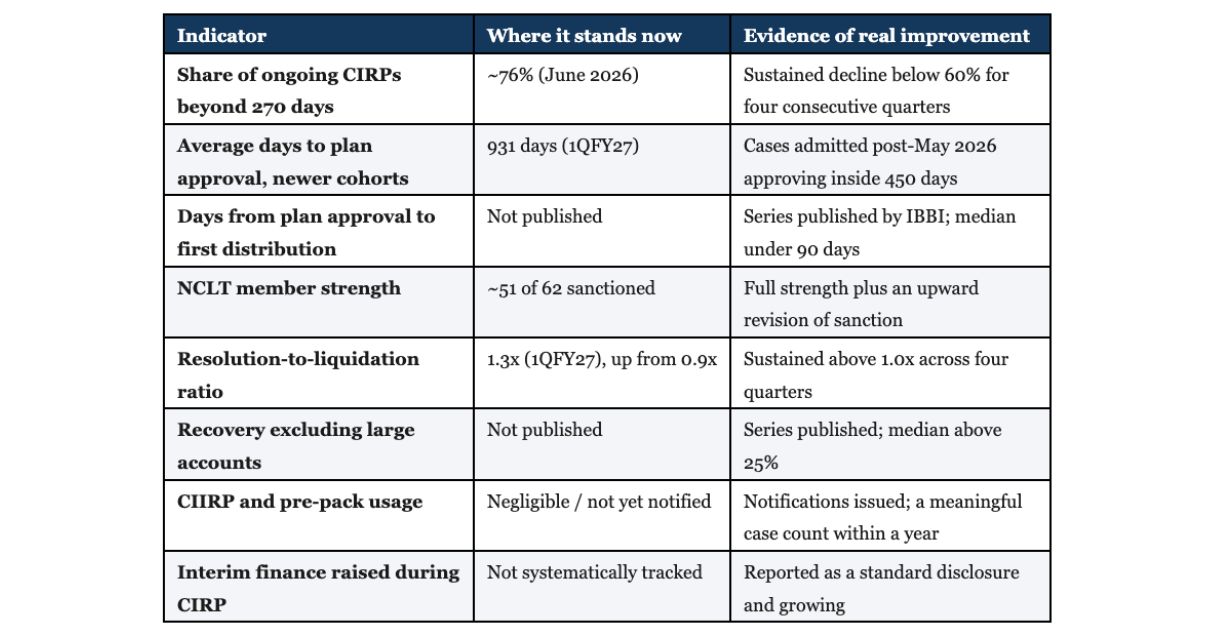
6. The Monitorable Scorecard
Reform claims should be tested against observable outputs, not against the ambition of the drafting. The following are the indicators that would demonstrate genuine structural improvement, as distinct from statistical noise or a favourable credit cycle.
7. Conclusion: The Clock Is the Creditor's Enemy
The Code was built on a simple insight: that the person best placed to decide whether a business should live or die is the creditor whose money is at stake, and that the decision must be made quickly, because distressed companies do not hold their value while lawyers argue. India got the first half right. It has never got the second half right, and the most recent data shows it is not getting closer.
What makes this a wake-up call rather than a routine complaint is the gap that has opened between expectation and evidence. Market participants, banks marking recoveries, ARCs underwriting security receipts, funds bidding for stressed portfolios, rating agencies assigning SR ratings , are increasingly pricing in the improvement that the 2026 Amendment Act promises. The data does not yet support that pricing. Recoveries are range-bound in the high twenties. Timelines lengthened in the most recent quarter rather than shortening. Three-quarters of live cases are already past the statutory extension.
The remedies are not mysterious, and most of them are not even controversial. Build the tribunal to the size of its docket. Make delay cost the delayer money. Separate the running of a business from the argument about its proceeds. Get assets into the process while they are still alive. Fund them while they are inside it. Publish numbers that tell the truth about time.