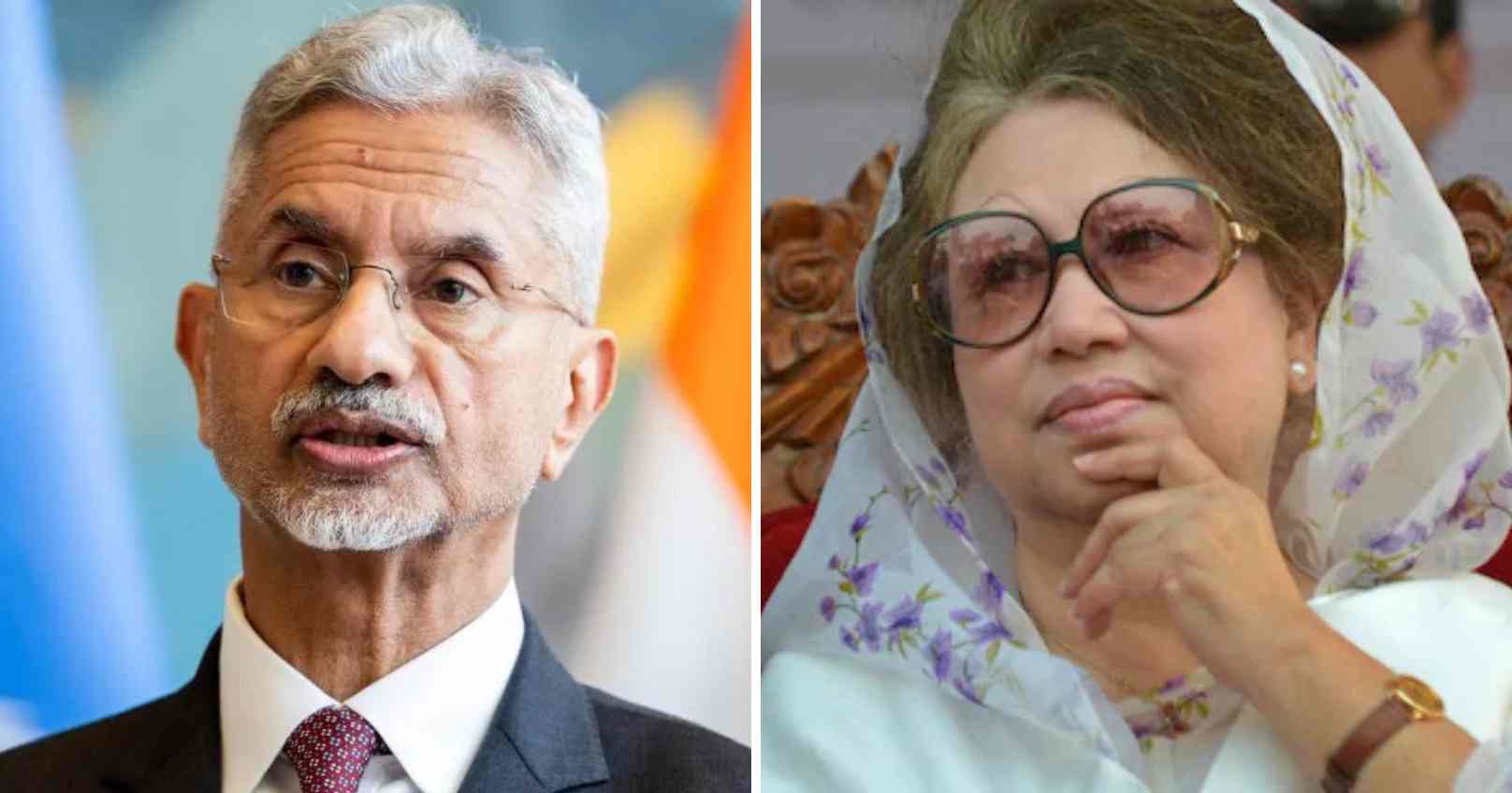
At a moment when relations between India and Bangladesh remain uneasy, External Affairs Minister S Jaishankar is set to travel to Dhaka on December 31 to attend the state funeral of former Prime Minister Khaleda Zia. The move is being closely watched as a diplomatic gesture from New Delhi amid shifting political currents in the neighbouring country.
Khaleda Zia’s passing comes shortly after her son, Tarique Rahman — the Bangladesh Nationalist Party’s key leader — returned home after spending nearly 17 years in exile. His comeback has added momentum to Bangladesh’s political landscape ahead of national elections.
India’s decision to send Jaishankar is widely viewed as an attempt to keep communication channels open with Dhaka, especially after relations deteriorated following the removal of Sheikh Hasina in a student-led uprising last year.
Zia, who served as prime minister in two separate stints during the 1990s and early 2000s, was often perceived as steering Bangladesh away from close alignment with India. During her tenure, Dhaka strengthened ties with China, including deeper defence cooperation — a development that caused concern in New Delhi.
With the interim government led by Muhammad Yunus keeping India at arm’s length, New Delhi has been increasingly cautious about Bangladesh’s growing engagement with both China and Pakistan. In this context, Tarique Rahman’s recent public statements have drawn attention.
Ahead of his return, Rahman questioned the authority of the interim administration to make long-term foreign policy decisions without an electoral mandate. Addressing supporters in Dhaka, he later emphasised a neutral foreign policy stance, stating that Bangladesh would prioritise its own interests over alignment with either India or Pakistan.
He has also distanced himself from radical Islamist groups, including Jamaat-e-Islami — once a BNP ally — and criticised its pro-Pakistan position during the 1971 Liberation War, a shift that New Delhi views with cautious optimism.
While India remembers that Bangladesh’s outreach to Pakistan expanded during Khaleda Zia’s rule, officials note that the current political dynamics differ from the past. The BNP’s strained relationship with Jamaat-e-Islami may offer India limited diplomatic room that did not exist earlier.
For decades, Khaleda Zia and her father, former President Ziaur Rahman, championed a foreign policy that resisted operating under India’s influence, despite New Delhi’s pivotal role in Bangladesh’s independence. Tarique Rahman’s recent “Bangladesh first” messaging reflects a continuation of that legacy rather than a sudden departure.
Jaishankar’s presence at Zia’s funeral, therefore, is seen less as an endorsement of past policies and more as a calibrated step by India to re-engage with Bangladesh during a period of political transition.