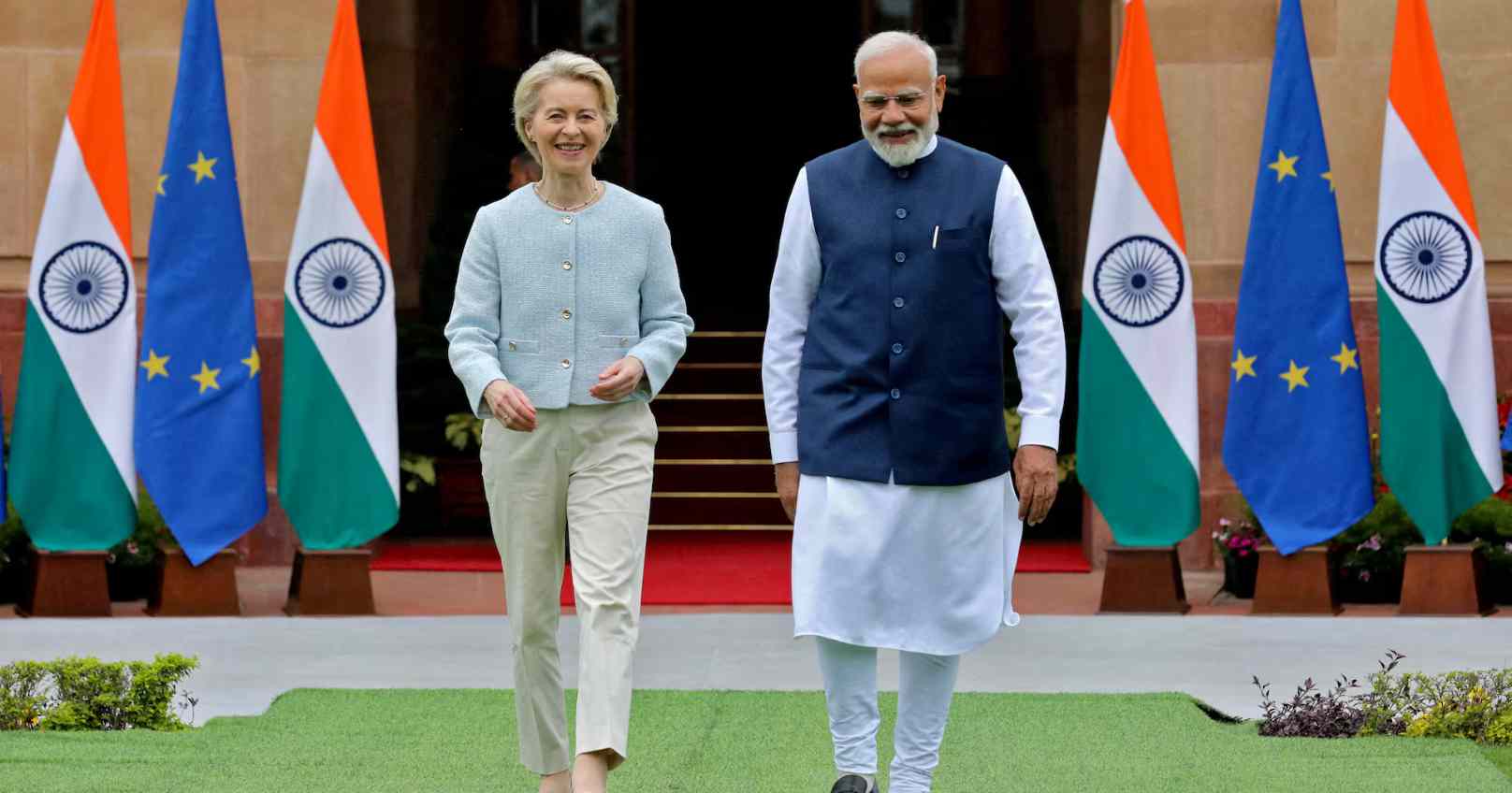
The European Union has expressed strong optimism about concluding a long-pending free trade agreement with India, with European Commission President Ursula von der Leyen describing the deal as being within reach during her address at the World Economic Forum in Davos. She suggested that the agreement could become a landmark economic partnership linking two major global markets.
Von der Leyen noted that while certain issues remain unresolved, negotiations have advanced to a decisive phase. She highlighted that the proposed pact would unite a consumer base of nearly two billion people and cover close to a quarter of global economic output, underscoring its strategic importance.
Strategic significance
The agreement is expected to have far-reaching implications for both sides. India, one of the fastest-expanding major economies, would gain broader access to the European market, enhancing its export potential and supporting its ambitions in manufacturing and services. For the EU, closer economic ties with India fit into a broader policy of diversifying trade relationships and reducing excessive dependence on any single country.
Analysts believe the pact could reshape global supply chains, especially as governments and businesses look for stable and trusted trade partners amid geopolitical uncertainties.
Years of negotiation
Talks between India and the EU began in 2007 but remained stalled for many years due to differences over tariffs and regulations. Momentum returned in 2022 when both sides revived discussions and created new mechanisms such as the Trade and Technology Council to address modern economic challenges, including digital governance, innovation and resilient supply networks.
Since then, multiple rounds of negotiations have helped bridge earlier gaps, and bilateral commerce has already expanded significantly. Trade in goods crossed €124 billion in 2023, while services exchanges are estimated at around €60 billion, driven largely by information technology and professional services.
Issues still unresolved
Despite the positive tone, negotiators must still settle sensitive matters. The EU is seeking greater market opening in sectors such as automobiles, alcoholic beverages and agricultural products. India, on the other hand, wants easier mobility for its skilled workforce and clearer rules on recognition of professional qualifications.
Discussions are also continuing on environmental standards, public procurement and regulatory alignment—areas that carry domestic political sensitivities on both sides.
Von der Leyen is scheduled to visit India in the coming days, a trip diplomats view as crucial for resolving the final sticking points. The visit precedes a planned India–EU leaders’ meeting where officials hope to showcase decisive progress, if not a formal announcement.
Potential impact
If finalised, the agreement would be among the most significant trade deals concluded by the EU in recent years and a major milestone for India’s global economic integration. It could stimulate investment, expand technology cooperation and provide businesses with more predictable access to each other’s markets.
Such a partnership would also send a strong signal of strategic convergence between Brussels and New Delhi at a time when the global trading order is undergoing rapid change.