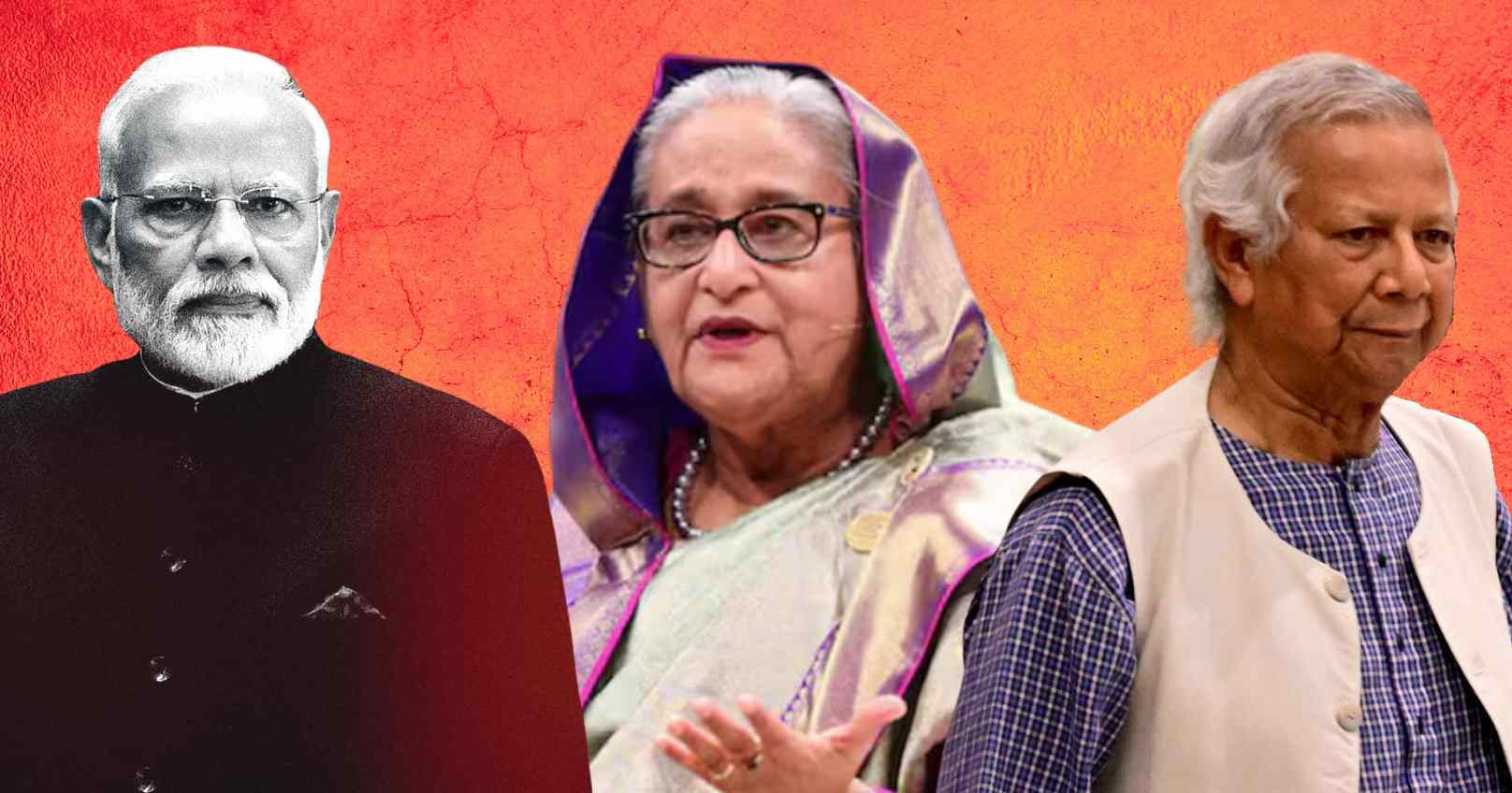
Hasina Sentenced to Death: Will India Hand Over Bangladesh’s Fallen PM?
As Dhaka demands immediate extradition, India faces a sensitive geopolitical dilemma with major regional implications
18-11-2025

Bangladesh’s ousted Prime Minister Sheikh Hasina has been handed a death sentence in absentia on charges of “crimes against humanity,” prompting Dhaka’s interim administration to formally request New Delhi to extradite her. Hasina has been residing in India since August 5 last year, when she escaped the country following a massive student-led revolt that toppled her 15-year rule.
The same court also declared Hasina and her former home minister, Asaduzzaman Khan Kamal—also believed to be in India—as fugitives before delivering its verdict.
The tribunal found Hasina guilty on five counts related to atrocities committed during last year’s uprising. She was sentenced to life imprisonment—until natural death—for allegedly inciting violence and ordering operations using helicopters, drones, and lethal weapons to suppress student demonstrators.
Additionally, she received the death penalty for her alleged role in the shooting deaths of six protesters in Dhaka’s Chankharpul area on August 5, 2024.
Chief prosecutor Tajul Islam described her as “the central figure responsible for every crime committed” during the unrest.
Calling the judgment biased and politically influenced, Hasina insisted she and her minister acted responsibly and sought to “minimise casualties,” not escalate them.
“We lost control of the situation, but portraying it as a deliberate attack on civilians is a distortion of reality,” she said in a statement issued on Monday. The Awami League, her party, has announced a nationwide shutdown to oppose the verdict.
At 78, Hasina cannot appeal unless she is arrested or voluntarily returns to Bangladesh within 30 days.
Dhaka’s Foreign Ministry urged India to immediately hand over Hasina and Kamal, citing the bilateral extradition treaty between the two neighbours.
The ministry said sheltering individuals convicted of crimes against humanity would be viewed as an “unfriendly” gesture and contrary to the pursuit of justice.
In its initial response, India said it had taken note of the tribunal’s verdict and reaffirmed its commitment to supporting peace, stability, and democratic processes in Bangladesh. However, it offered no comment on whether Hasina would be extradited.
The Ministry of External Affairs stated, “As a close neighbour, India remains committed to the best interests of the people of Bangladesh and will continue to engage constructively with all stakeholders.”
Despite Bangladesh’s insistence, legal experts believe New Delhi is unlikely to extradite Hasina. Both Indian law and the bilateral treaty allow India to reject extradition requests if they appear politically motivated, unjust, or lacking in good faith.
India and Bangladesh signed their extradition treaty in 2013 and amended it in 2016 to streamline the transfer of fugitives.
A key requirement is dual criminality—the offence must be recognised as a crime in both countries. While Hasina’s conviction technically satisfies this condition, the treaty gives India wide discretion.
Under Article 8, extradition can be denied if it would be “unjust or oppressive,” or if the accused can show the request is made in bad faith, relates to a trivial offence, is purely military, or could lead to persecution.
Article 6 allows refusal if the offence is political in nature—though crimes like murder, terrorism, and torture cannot be dismissed as political. Since the charges against Hasina involve murder and other grave crimes, this clause may not support India’s refusal unless it argues the case is politically driven.
Under Article 7, India can also reject extradition if it chooses to prosecute the individual under its own laws.
India’s Extradition Act further expands the Centre’s authority.
Section 29 permits India to deny extradition if the request is politically motivated, not made in good faith, trivial, or against the interests of justice. The government can pause or stop proceedings anytime, cancel warrants, or release the accused.

Donald Trump has again claimed that threats of 250 per cent tariffs helped stop the 2025 India-Pakis
Read More
The BJP has alleged a rift between Rahul Gandhi and Priyanka Gandhi Vadra over the removal of photog
Read More
Sonia Gandhi has joined X with a memory of meeting Rajiv Gandhi in Cambridge, introducing her upcomi
Read More