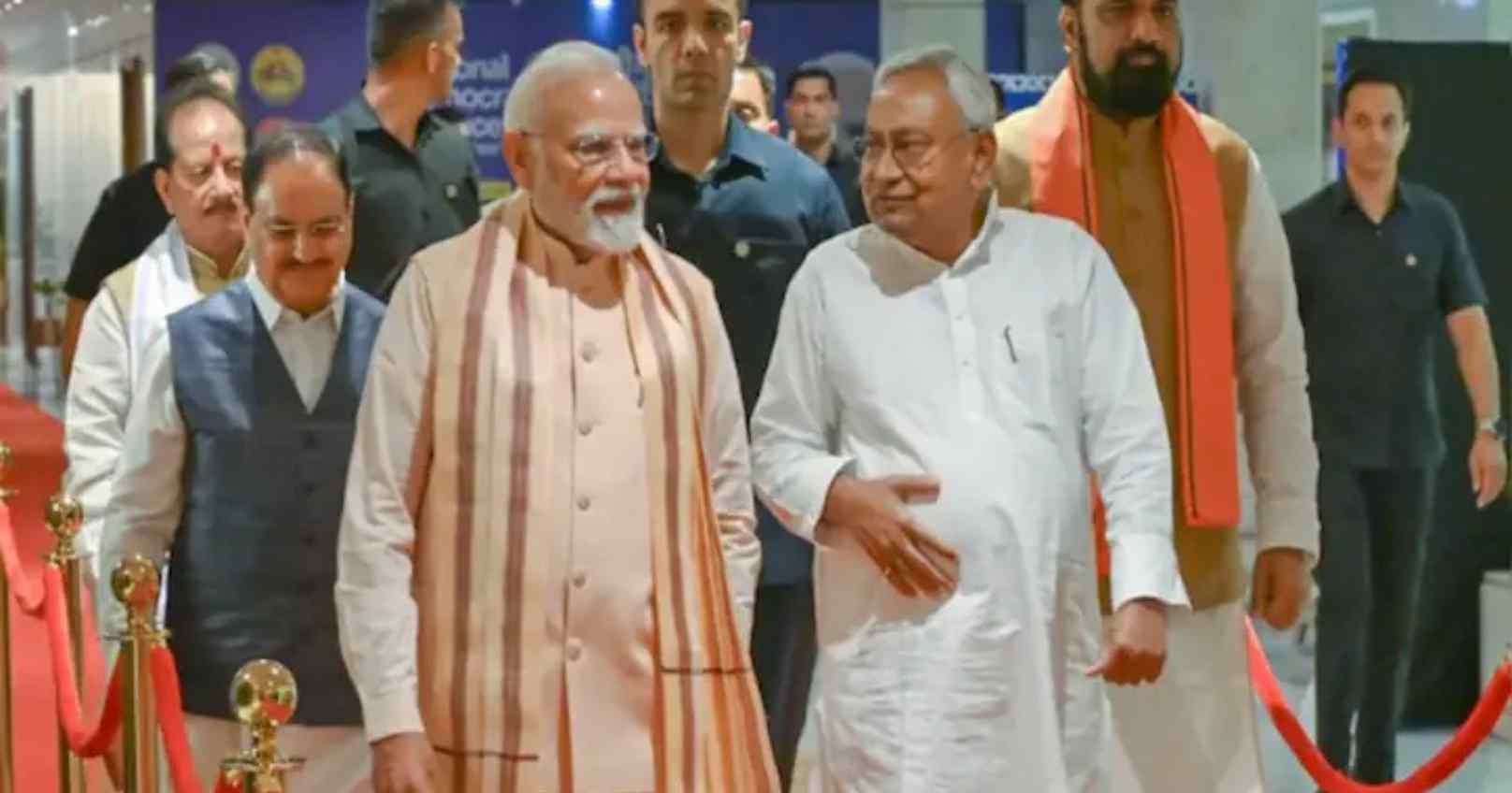
The National Democratic Alliance has stormed back to power in Bihar with a thumping mandate, powered by a sharp caste coalition and an unexpectedly strong wave in favour of Chief Minister Nitish Kumar. The result has left the Opposition in tatters, with Tejashwi Yadav’s RJD collapsing to less than half of what it won in 2020.
The NDA’s victory is decisive: it secured 202 of Bihar’s 243 assembly seats, leaving the Mahagathbandhan with a mere 35. Calling the verdict a political “storm”, Prime Minister Narendra Modi credited the support of women and young voters, saying the results had created a new ‘MY’ formula — “Mahila and Youth” — replacing what he described as the Opposition’s old “appeasement politics”.
The Prime Minister also used the Bihar mandate to signal political intent beyond the state, declaring that the “Ganga of victory” would flow toward Bengal next, promising to rid the neighbouring state of “Jungle Raaj”.
Within the NDA fold, the BJP emerged as the senior partner with 89 seats, followed closely by Nitish Kumar’s JDU with 85. Smaller allies, including Chirag Paswan’s Lok Janshakti Party (Ram Vilas), Jitan Ram Manjhi’s Hindustani Awam Morcha, and Upendra Kushwaha’s Rashtriya Lok Morcha, contributed to the coalition’s sweeping performance.
On the Opposition side, the results were bleak. The RJD could manage only 25 seats, the Congress slid to six, while the Left parties won a handful combined. Tejashwi Yadav did retain Raghopur — his family’s traditional stronghold — but what was expected to be an easy win turned into an all-day cliffhanger.
Prashant Kishor’s Jan Suraaj Party, once considered a potential disruptor, fell flat, failing to make any electoral dent. Instead, the unexpected spoiler came from Asaduddin Owaisi’s AIMIM, which bagged five seats in the Seemanchal region, buoyed by a consolidated Muslim vote bank.
The RJD’s steep decline stands in stark contrast to its 2020 performance, when it won 75 seats and emerged as the state’s largest party, sparking hopes that it could close the gap this time. Instead, the Opposition now finds itself so marginalised that it may struggle even to claim the position of Leader of the Opposition.
For the BJP, the outcome reinforces a shift that began in 2020, when the party, for the first time, overshadowed its long-standing ally JDU. While Nitish Kumar’s party has significantly improved on its previous tally, the BJP continues to set the tone within the alliance.
Analysts say the NDA’s remarkable sweep is a combination of strong female voter turnout, broad-based caste outreach, and the fragmentation of the non-NDA vote — a trend underlined by Jan Suraaj performing worse than NOTA in several constituencies.
With this mandate, Bihar has delivered one of its most decisive political verdicts in recent years, redrawing the state's power equations once again.