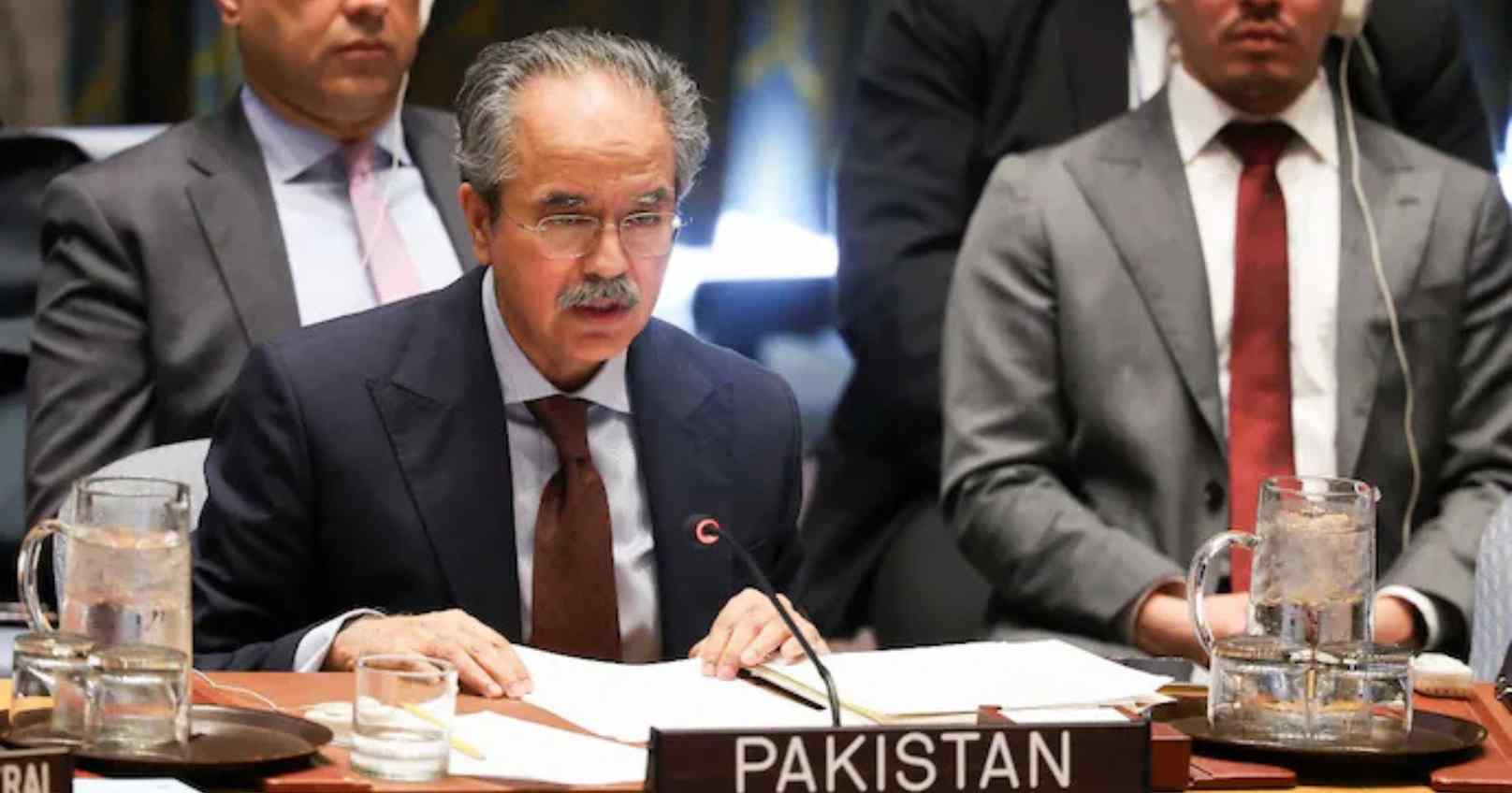
Pakistan Flags Afghan Terror Threat at UN, But Its Own Role Draws Global Side-Eye
At the UN, Pakistan warned of militant threats from Afghanistan, sparking criticism over its decades-long support for the Taliban and terror networks
09-07-2025

At the UN, Pakistan warned of militant threats from Afghanistan, sparking criticism over its decades-long support for the Taliban and terror networks
09-07-2025In a striking display of irony, Pakistan has cautioned the United Nations about Afghanistan turning into a hub for terrorism—a fear long stoked by Islamabad’s own policies.
Speaking at a UN General Assembly session on Afghanistan, Pakistan’s envoy Asim Iftikhar Ahmad warned of militant outfits like the Tehreek-e-Taliban Pakistan (TTP), al-Qaeda, and ISIS-K exploiting lawless regions in Afghanistan to launch cross-border assaults. He highlighted recent attacks on Pakistani soil and claimed that TTP is coordinating with Baloch insurgents such as the Baloch Liberation Army to strike critical infrastructure.
Yet, Ahmad’s appeal was silent on Pakistan’s extensive history of aiding and sheltering the Afghan Taliban. Since its inception in the 1990s, the Taliban found sanctuary and support across the border in Pakistan—aid that continued until the group’s dramatic comeback in 2021.
The TTP, a Pakistani offshoot of the Taliban, has emerged as a major threat within Pakistan. Earlier this year, around 15,000 Taliban fighters reportedly amassed near the Durand Line after Pakistan launched airstrikes targeting TTP strongholds inside Afghanistan. These retaliatory moves have escalated tensions and violence, especially in border regions like North Waziristan.
So far in 2024, over 550 people have lost their lives in TTP-led attacks across Pakistan, as the group continues to carry out bombings, assassinations, and raids on military posts. The scale and frequency of violence mirror the Taliban’s resurgence in Afghanistan—raising questions about Islamabad’s long-standing use of proxy actors to shape regional dynamics.
In his speech, the ambassador also attempted to pin cross-border violence on India, accusing “India-backed terrorists” of destabilising Pakistan—an oft-repeated narrative used by Islamabad to deflect scrutiny from its internal security failures. However, he avoided addressing Pakistan's track record of sheltering anti-India and anti-Afghan groups like Lashkar-e-Taiba and Jaish-e-Mohammed.
Following the US exit from Afghanistan in 2021, Pakistan’s intelligence agency, the ISI, reportedly played a behind-the-scenes role in the Taliban’s rapid capture of Kabul, providing strategic and logistical support. That same power shift has now become a source of blowback, with Afghanistan-based terror groups increasingly turning their guns on Pakistan.
Interestingly, even as it raises alarm at the UN, Pakistan is calling for global assistance to manage Afghan refugees and stabilise Afghanistan's economy—an appeal that sits awkwardly with its past actions that helped enable the very instability it now decries.
Unless Pakistan confronts its own involvement in fostering extremist networks, such warnings are likely to be seen less as serious security concerns and more as an exercise in historical denial and strategic hypocrisy.

Donald Trump has again claimed that threats of 250 per cent tariffs helped stop the 2025 India-Pakis
Read More
The BJP has alleged a rift between Rahul Gandhi and Priyanka Gandhi Vadra over the removal of photog
Read More
Sonia Gandhi has joined X with a memory of meeting Rajiv Gandhi in Cambridge, introducing her upcomi
Read More