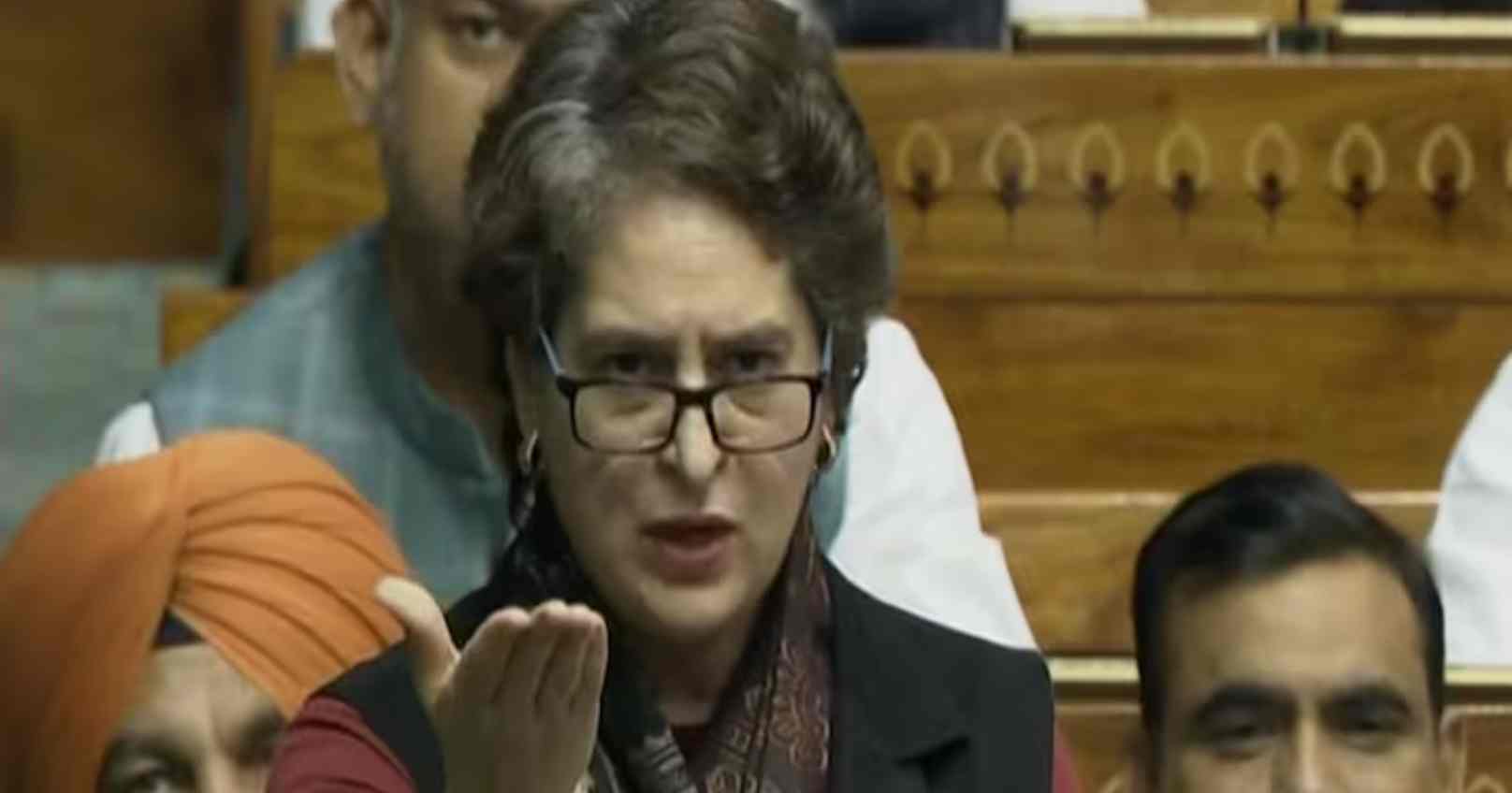
A heated exchange unfolded in Parliament during discussions marking 150 years of the national song Vande Mataram, with Congress leader Priyanka Gandhi Vadra accusing the government of stirring the issue for political gains ahead of the Bengal assembly polls. She argued that the ruling party was deliberately diverting attention from urgent national matters and misrepresenting historical facts.
Priyanka questioned the need for such a debate at all, insisting that Vande Mataram “resonates everywhere in the country” and does not require parliamentary scrutiny. She also accused Prime Minister Narendra Modi of selectively quoting Jawaharlal Nehru and urged the BJP to compile whatever grievances it has against India’s first Prime Minister so the matter can be settled once and for all. “Let this House focus on the issues citizens expect us to address,” she said.
PM Modi’s Charge Against Congress
In his speech, Prime Minister Modi alleged that the Congress leadership, under Nehru, had diluted Vande Mataram under pressure from the Muslim League. Modi claimed Nehru had echoed Muhammad Ali Jinnah’s view that parts of the song could offend Muslims, and in doing so, compromised its legacy.
According to the Prime Minister, Nehru even wrote to Subhas Chandra Bose accepting that certain sections of the hymn might trigger discomfort among Muslims due to its connection with Anandamath. Modi said the Congress position at the time stemmed from appeasement politics that eventually contributed to Partition.
Priyanka Counters PM, Cites Historical Letters
Responding sharply, Priyanka Gandhi Vadra said the Prime Minister’s interpretation distorted the historical record. She cited written exchanges between Nehru, Subhas Bose and Rabindranath Tagore, saying Nehru had actually termed the controversy “manufactured by communal elements”.
Reading from Tagore’s letter, she said the poet had clearly stated that the first two stanzas—frequently sung during the freedom movement—could be separated from the rest of the poem without difficulty. Tagore had also noted that other portions added later might carry interpretations unsuitable for the sociopolitical climate of that time. Based on these considerations, she said, the Congress Working Committee declared these two stanzas as the national song in its 1937 resolution.
DMK MP A Raja supported this reading, recalling that Nehru had recognised some concerns but maintained that the agitation around the song was largely contrived.
Why Vande Mataram Matters
India marked 150 years of Vande Mataram on November 7. Written by Bankim Chandra Chatterjee and first published in the journal Bangadarshan in 1875, the hymn later appeared in his novel Anandamath and became a rallying cry during the freedom struggle. Rabindranath Tagore later set it to tune, and over time, the song became deeply embedded in India’s national consciousness.