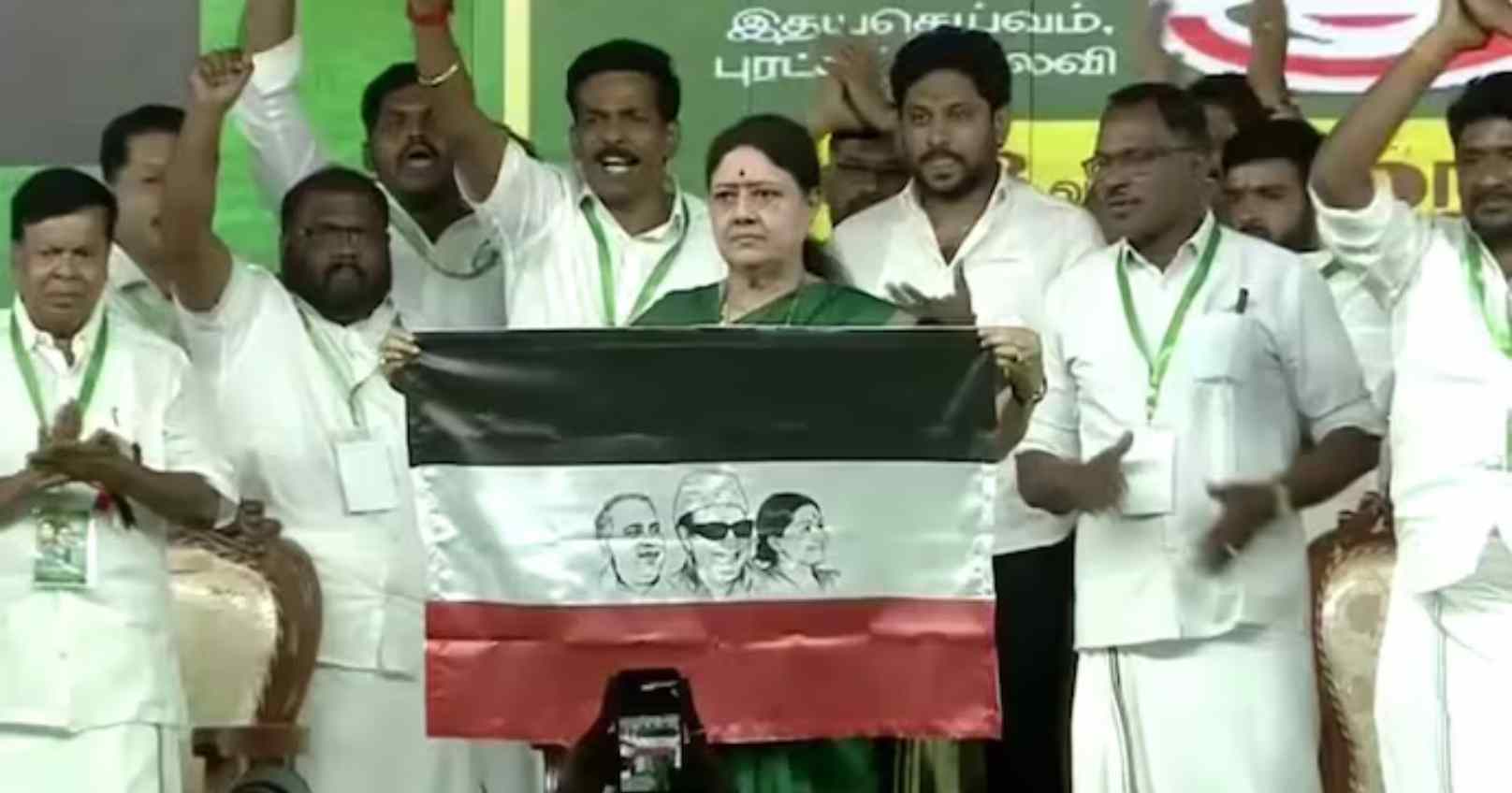
In a significant development in Tamil Nadu’s political landscape, expelled AIADMK leader V. K. Sasikala on Tuesday declared that she will establish a new political party, positioning it as a revival of the ideological path laid down by J. Jayalalithaa.
Addressing supporters, Sasikala said the proposed party would be guided by the principles associated with “Puratchi Thalaivi Amma,” along with the legacies of M. G. Ramachandran and C. N. Annadurai. She asserted that remaining politically inactive for nearly nine years would amount to failing the people of Tamil Nadu.
Sharp Criticism of AIADMK Leadership
Sasikala used the announcement to criticise her former party, the All India Anna Dravida Munnetra Kazhagam, claiming it has been in steady decline. She accused party chief Edappadi K. Palaniswami of neglecting grassroots workers and prioritising personal interests over organisational revival.
She alleged that after her release from prison, efforts were made within the party to politically sideline her. According to Sasikala, the AIADMK’s repeated electoral setbacks signal a loss of direction, contrasting it with what she described as the enduring public goodwill earned during Jayalalithaa’s tenure.
Targeting the Ruling DMK
In her remarks, Sasikala also took aim at the ruling Dravida Munnetra Kazhagam government, accusing it of misgovernance and failing the electorate. She argued that voters have not forgotten the welfare-oriented governance associated with earlier AIADMK administrations.
Her move is widely seen as a direct challenge to the present AIADMK leadership, especially as the state prepares for a high-stakes electoral battle.
Legal Hurdles and Political Comeback
Sasikala is currently barred from contesting elections until 2027 due to her conviction in a disproportionate assets case that also named Jayalalithaa. She was released from prison in 2021 after serving a four-year sentence. Following Jayalalithaa’s death in December 2016, Sasikala had briefly assumed the role of AIADMK general secretary before internal party conflicts led to her expulsion.
The announcement of her new party came after a strategy meeting with loyalists in Chennai, signalling her intent to re-enter Tamil Nadu’s political arena despite legal constraints.
As election season approaches, Sasikala’s re-emergence could reshape alliances and fragment vote bases within the state’s Dravidian political spectrum.