Thackeray Cousins Reunite After 20 Years, Stir Alliance Buzz at Worli Rally
Uddhav and Raj Thackeray’s joint appearance in Mumbai signals a potential political realignment ahead of key civic polls
05-07-2025

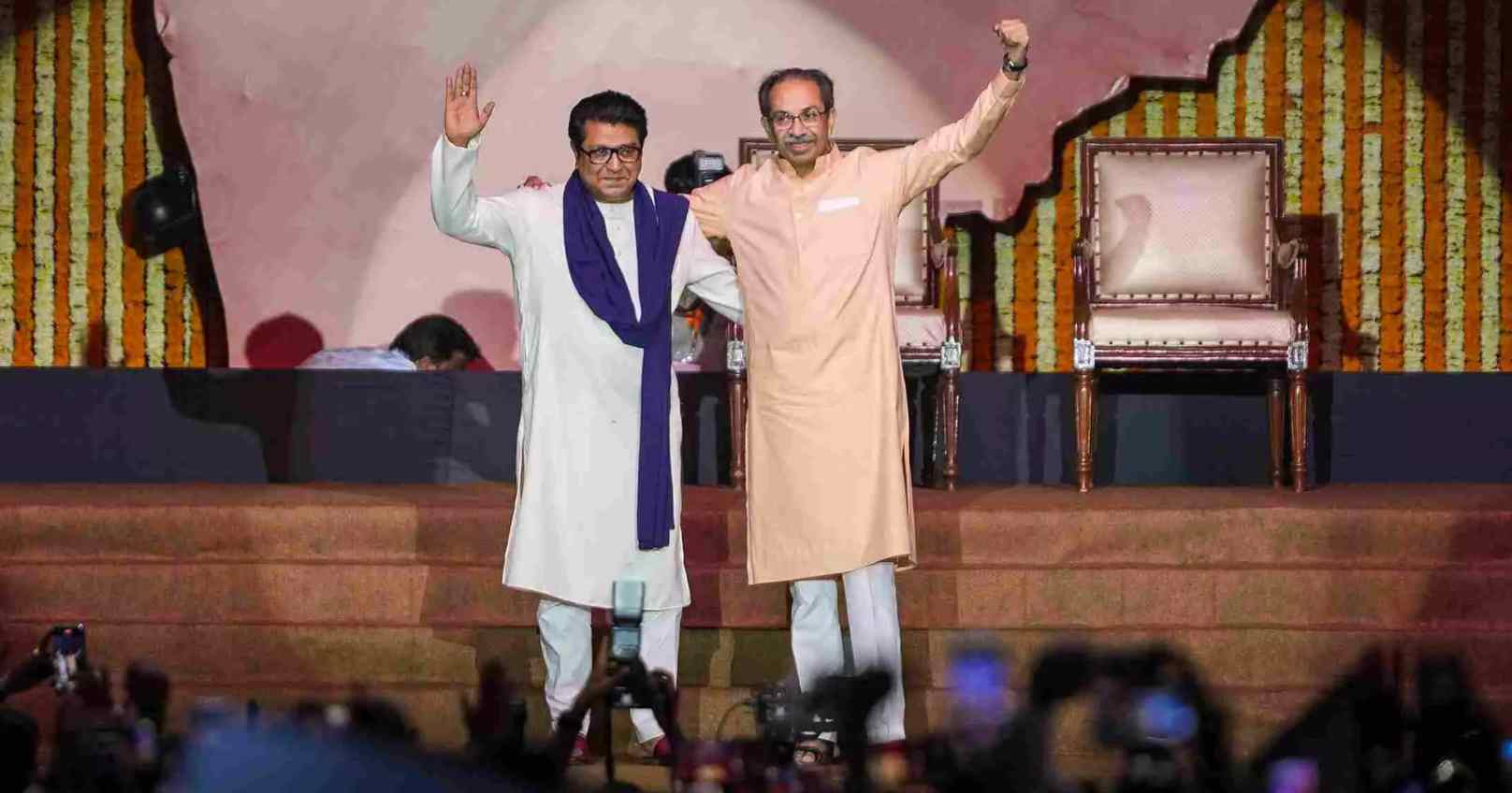
In a rare public show of unity, Uddhav Thackeray and his cousin Raj Thackeray came together on stage after nearly 20 years, drawing attention and speculation at a victory rally held at Mumbai’s Worli Dome on Saturday. The event celebrated the Maharashtra government’s move to withdraw Government Resolutions (GRs) tied to the contentious three-language policy in primary education.
Although the gathering was presented as a non-political celebration, it carried heavy political overtones rooted in Marathi identity—a theme that has long underpinned the political journeys of both cousins. Their reunion has now fueled talk of a potential alliance ahead of crucial civic polls, most notably the Brihanmumbai Municipal Corporation (BMC) elections, potentially shifting the state’s political calculus.
Raj Thackeray, who broke away from the unified Shiv Sena in 2006 to form the Maharashtra Navnirman Sena (MNS), remained sharply focused on the cause of Marathi pride during his speech. His remarks struck a chord with attendees and reinforced his consistent messaging around safeguarding the interests of the Marathi-speaking populace.
Uddhav Thackeray, leader of the Shiv Sena (UBT), took the opportunity to hit out at his political adversaries. He criticised Deputy Chief Minister Eknath Shinde for promoting a “Jai Gujarat” sentiment and accused the BJP of promoting divisive narratives. While Uddhav hinted at rekindling political ties with Raj, the latter kept his cards close to his chest, steering clear of direct commentary on any electoral alliance.
Still, their joint appearance served as a powerful image—one that evoked nostalgia about the Thackeray family’s once-unified grip on Maharashtra’s political stage.
The possibility of a Shiv Sena (UBT)–MNS partnership has the potential to reshape the electoral equation in urban Marathi-dominated pockets such as Mumbai, Pune, Nashik, and surrounding areas. Neighbourhoods like Lalbaug, Parel, Worli, Sewri, and Byculla have been historical battlegrounds for the two parties, and a combined strategy could help consolidate their traditional vote bases.
Yet, a formal tie-up wouldn’t be without its complications. The two parties differ significantly in organisational style and political approach, and they also share a history of competition. Managing internal leadership expectations, negotiating seat-sharing, and reconciling differing ideologies will be essential—and difficult—tasks if a formal alliance is to materialise.
Saturday’s rally also served as a trial run for their ability to mobilise the Marathi electorate on the plank of cultural identity, a political strategy that both parties have leaned on in the past. The crowd’s response indicated that the emotional appeal of regional pride remains strong.
Interestingly, the biggest unintended winner from a potential Thackeray alliance could be the BJP. As the cousins rally Marathi voters around shared identity and language, the BJP could secure its grip on the non-Marathi urban electorate—an influential demographic in cities like Mumbai and Thane. This shift could squeeze both the Eknath Shinde-led Shiv Sena faction and opposition parties such as the Congress.
The broader Maha Vikas Aghadi (MVA) coalition—comprising Shiv Sena (UBT), Congress, and Sharad Pawar’s NCP—might also feel the strain. Raj Thackeray’s polarising views, particularly his vocal stance against mosque loudspeakers, risk alienating Muslim voters, who form a critical part of the MVA’s base. Any friction within the alliance could force difficult recalibrations of electoral strategy.
The withdrawal of the three-language policy was portrayed as a cultural triumph and a win for Marathi linguistic preservation. By linking the move to the larger issue of regional pride, the Thackeray cousins struck an emotional chord with their followers.
However, leaning heavily on identity politics could also alienate other communities in Maharashtra’s cosmopolitan cities. To succeed electorally, Uddhav and Raj will have to blend the appeal of Marathi asmita (pride) with a message of inclusivity that reaches across community lines.
Whether the rally marks the beginning of a political reunion or remains a symbolic gesture, it has already stirred Maharashtra’s political waters—and all eyes will be on how the cousins choose to navigate this renewed chapter.

Donald Trump has again claimed that threats of 250 per cent tariffs helped stop the 2025 India-Pakis
Read More
The BJP has alleged a rift between Rahul Gandhi and Priyanka Gandhi Vadra over the removal of photog
Read More
Sonia Gandhi has joined X with a memory of meeting Rajiv Gandhi in Cambridge, introducing her upcomi
Read More