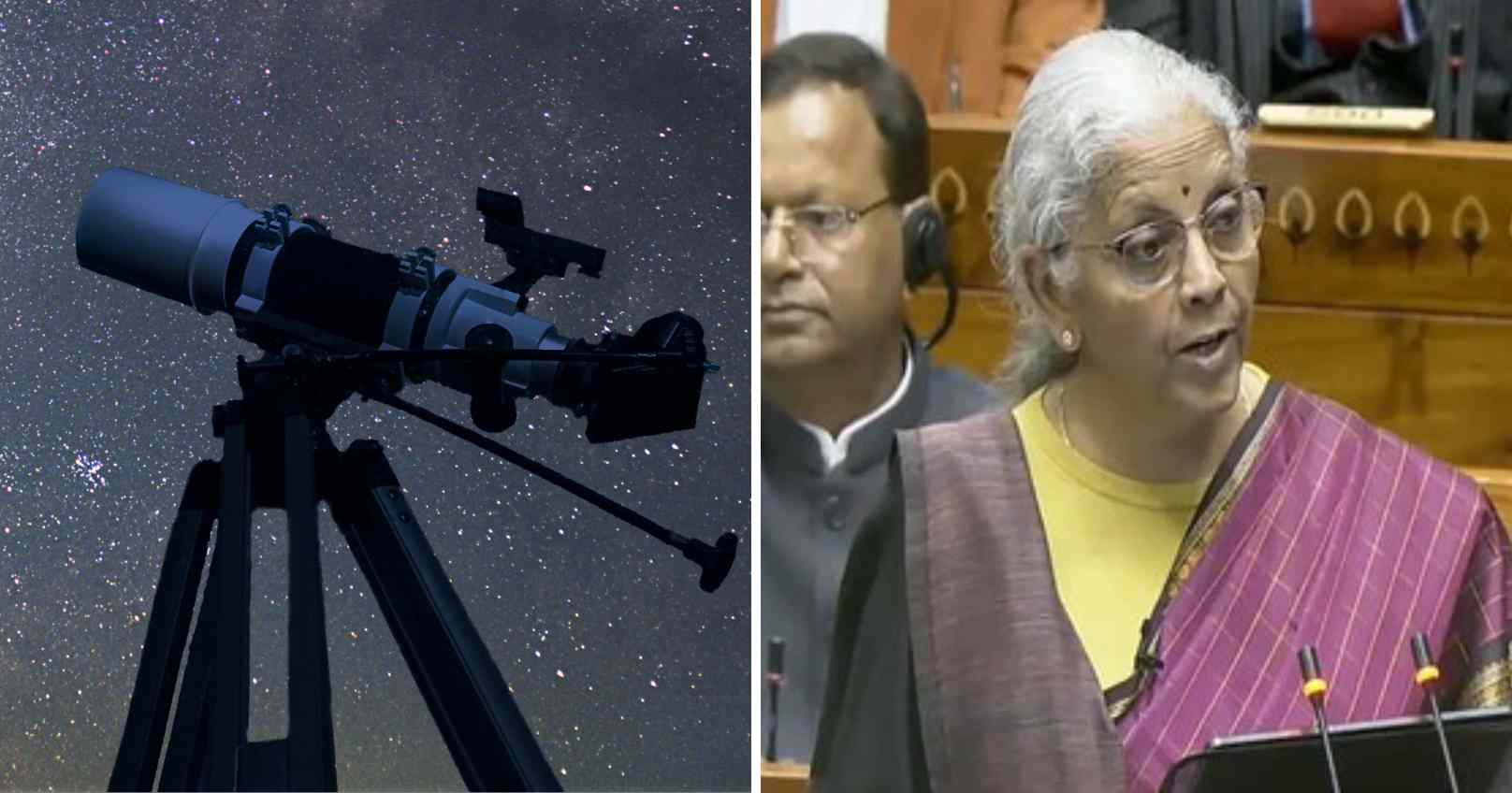
India is set to significantly expand its astronomical research capabilities after the Union Budget 2026 announced new investments in advanced telescope infrastructure. Finance Minister Nirmala Sitharaman revealed the initiative in Parliament, highlighting the government’s goal of strengthening scientific exploration and innovation.
The funding will support the development and modernisation of four major astronomy and space science facilities, aimed at improving India’s ability to study the Sun, distant stars, galaxies, and the broader universe. The move is expected to elevate India’s global standing in astrophysics while encouraging young minds to pursue careers in space science.
Among the flagship projects is the National Large Solar Telescope (NLST), which will enable highly detailed observations of the Sun. This facility will help scientists better understand solar flares, magnetic activity, and space weather — phenomena that can influence satellite systems, telecommunications, and power networks on Earth.
Another major addition is the National Large Optical Infrared Telescope (NLOT), designed to observe faint and faraway cosmic objects. By operating across optical and infrared wavelengths, it will support advanced research into exoplanets, star formation, and the evolution of galaxies.
The Budget also includes plans to enhance the Himalayan Chandra Telescope in Ladakh, one of the highest observatories in the world. The upgrade will improve its performance, allowing astronomers to capture clearer and more precise data under excellent atmospheric conditions.
Additionally, the COSMOS 2 Planetarium will be developed as a modern science education and outreach hub. It aims to make astronomy more accessible and engaging for students and the general public, fostering curiosity and scientific awareness.
Together, these projects reflect a long-term commitment to strengthening India’s scientific infrastructure, advancing space research, and inspiring future generations of researchers.